
Hiring the wrong virtual assistant can cost you thousands of dollars, countless hours, and significant frustration. Yet 67% of businesses report struggling to find qualified VAs who meet their standards. The difference between a transformative hire and a costly mistake comes down to understanding the essential virtual assistant qualifications you should evaluate before making a hiring decision.
This comprehensive guide provides a detailed hiring checklist covering every critical aspect of VA skills assessment and the complete screening process. Whether you’re hiring your first virtual assistant or building an entire remote team, this checklist ensures you identify candidates with the right combination of technical skills, soft skills, and professional attributes to excel in your business.
Why Virtual Assistant Qualifications Matter More Than You Think

The virtual assistant industry has exploded in recent years, creating a vast pool of candidates with wildly varying skill levels. Without a systematic approach to evaluating virtual assistant qualifications, you’re essentially gambling on whether someone can actually deliver the support your business needs.
The Hidden Cost of Poor Hiring
Hiring an unqualified VA creates cascading problems:
- Time waste – Correcting mistakes often takes longer than doing tasks yourself
- Revenue loss – Missed deadlines and poor quality work damage client relationships
- Opportunity cost – Your focus stays on management instead of growth
- Recruitment cycling – Starting the hiring process over multiplies these costs
- Team morale impact – Unreliable team members create stress for everyone
Industry research shows that replacing a poor hire costs approximately 30% of their annual value when you factor in recruitment time, training investment, and productivity loss. A thorough screening process prevents these expensive mistakes.
The ROI of Proper Qualification Assessment
Investing time in comprehensive VA skills assessment delivers measurable returns:
- Faster productivity – Qualified VAs require 60% less training time
- Higher quality output – Proper qualifications translate directly to better work
- Greater autonomy – Skilled VAs solve problems independently
- Lower turnover – Good fits stay longer, reducing recruitment costs
- Strategic value – Top performers grow into strategic partners, not just task executors
Core Technical Qualifications Every VA Should Possess
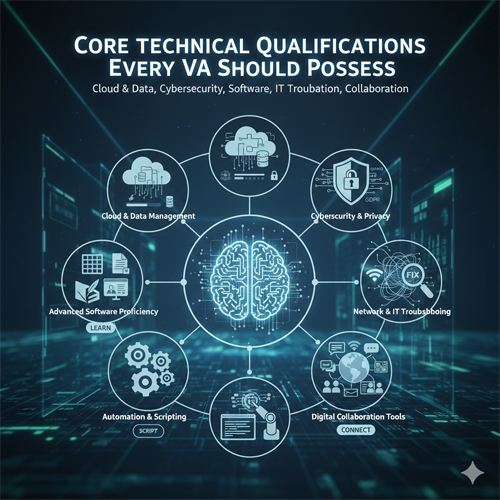
The foundation of virtual assistant qualifications begins with technical competencies. These baseline skills enable VAs to perform standard tasks efficiently across most business environments.
1. Software and Platform Proficiency
Your hiring checklist should verify competence in these essential platforms:
Office Suite Mastery
- Google Workspace – Docs, Sheets, Slides, Drive, Calendar (most common)
- Microsoft Office 365 – Word, Excel, PowerPoint, Outlook, Teams
- Advanced features – Mail merge, pivot tables, formulas, template creation
Communication Platforms
- Email management (Gmail, Outlook)
- Instant messaging (Slack, Microsoft Teams, Discord)
- Video conferencing (Zoom, Google Meet, Microsoft Teams)
- Phone systems (VoIP, call forwarding, voicemail management)
Project Management Tools
- Task management platforms (Asana, Trello, Monday.com, ClickUp)
- Time tracking software (Toggl, Harvest, Time Doctor)
- File organization and sharing (Dropbox, Google Drive, OneDrive)
Industry-Specific Software
Depending on your needs, evaluate familiarity with:
- CRM systems – Salesforce, HubSpot, Pipedrive, Zoho
- Accounting software – QuickBooks, Xero, FreshBooks
- E-commerce platforms – Shopify, WooCommerce, Amazon Seller Central
- Social media tools – Buffer, Hootsuite, Later, Meta Business Suite
- Design tools – Canva, Adobe Creative Suite basics, Figma
2. Digital Literacy and Tech Adaptability
Beyond specific software, strong virtual assistant qualifications include general technology comfort:
- Quick learning – Ability to master new tools independently using help documentation
- Basic troubleshooting – Can resolve common technical issues without constant IT support
- File management – Organized folder structures, naming conventions, version control
- Internet research – Advanced search techniques, source verification, information synthesis
- Security awareness – Password management, phishing recognition, data protection practices
3. Typing Speed and Data Entry Accuracy
Include this in your VA skills assessment:
- Minimum typing speed – 50-60 WPM for general tasks, 70+ WPM for transcription or heavy data entry
- Accuracy standard – 95%+ accuracy on typing tests
- Data entry precision – Double-entry verification, quality checking habits
- Attention to detail – Catches errors before submission, maintains consistent formatting
Essential Soft Skills That Separate Great VAs from Average Ones

Technical skills get the job done, but soft skills determine whether a VA becomes an invaluable asset or a constant source of frustration. Your hiring checklist must evaluate these critical interpersonal and professional attributes.
1. Communication Excellence
Communication ranks as the most important soft skill in any screening process. Virtual work magnifies communication challenges, making this non-negotiable.
Written Communication
- Grammar and spelling – Professional, error-free writing in all correspondence
- Clarity and conciseness – Conveys information efficiently without ambiguity
- Tone adaptability – Adjusts formality and style to audience and context
- Email etiquette – Professional subject lines, appropriate greetings, clear call-to-actions
Verbal Communication
- Clear articulation – Speaks clearly without heavy accents that impede understanding (if phone work required)
- Active listening – Asks clarifying questions, confirms understanding, takes accurate notes
- Professional phone manner – Courteous, warm, and competent in client interactions
Proactive Updates
- Status communication – Provides regular progress updates without prompting
- Problem alerting – Flags issues early rather than letting them fester
- Availability transparency – Clearly communicates working hours and response timeframes
2. Time Management and Organization
Remote work requires exceptional self-management. Include these in your VA skills assessment:
- Deadline reliability – Consistently meets or beats deadlines without excuses
- Priority management – Distinguishes urgent from important, handles competing demands effectively
- Task tracking – Uses systems to ensure nothing falls through cracks
- Workflow optimization – Finds efficiencies, suggests process improvements
- Distraction management – Maintains focus and productivity without direct supervision
3. Problem-Solving and Critical Thinking
Top-tier virtual assistant qualifications include intellectual agility:
- Independent decision-making – Makes sound judgments within defined parameters
- Creative solutions – Finds workarounds when standard approaches don’t work
- Root cause analysis – Identifies underlying issues rather than just treating symptoms
- Resourcefulness – Finds answers through research and experimentation
- Escalation judgment – Knows when to solve independently vs. when to involve you
4. Attention to Detail and Quality Orientation
Detail orientation prevents costly mistakes:
- Accuracy obsession – Double-checks work before submission
- Pattern recognition – Spots errors, inconsistencies, or anomalies
- Quality standards – Takes pride in producing polished, professional work
- Proofreading discipline – Reviews all written communication for errors
- Consistency maintenance – Follows brand guidelines, templates, and established processes
5. Adaptability and Learning Agility
Business needs evolve. Your VA must evolve with them:
- Change tolerance – Embraces new processes without resistance
- Quick skill acquisition – Masters new tools and methods rapidly
- Feedback receptivity – Accepts constructive criticism gracefully and implements changes
- Growth mindset – Seeks improvement opportunities, views challenges as learning experiences
- Industry awareness – Stays current with trends and best practices in relevant fields
6. Professionalism and Reliability
These foundational traits ensure consistent performance:
- Dependability – Shows up when expected, honors commitments
- Integrity – Honest about mistakes, capabilities, and time tracking
- Discretion – Maintains confidentiality with sensitive business and client information
- Work ethic – Delivers full effort during work hours, doesn’t cut corners
- Accountability – Takes ownership of results, doesn’t make excuses
Specialized Skills for Specific VA Roles

Beyond general virtual assistant qualifications, certain roles require specialized expertise. Tailor your hiring checklist based on your specific needs:
Administrative and Executive Assistant Specialists
- Calendar management mastery – Complex scheduling, time zone coordination, conflict resolution
- Travel coordination – Itinerary planning, booking optimization, expense management
- Meeting facilitation – Agenda creation, minute-taking, action item tracking
- Executive correspondence – High-level writing, stakeholder communication
Customer Service and Support Specialists
- Empathy and patience – Handles frustrated customers with grace
- Help desk software – Zendesk, Intercom, Freshdesk, Help Scout
- Conflict resolution – De-escalation techniques, problem-solving
- Product knowledge retention – Quickly learns complex offerings
Social Media Management Specialists
- Platform expertise – Deep knowledge of Facebook, Instagram, LinkedIn, Twitter, TikTok
- Content creation – Copywriting, basic graphic design, video editing
- Community management – Engagement, comment moderation, relationship building
- Analytics interpretation – Understanding metrics, ROI tracking, performance optimization
Bookkeeping and Finance Specialists
- Accounting software – QuickBooks, Xero, FreshBooks certification
- Financial accuracy – Reconciliation, error detection, audit readiness
- Accounts payable/receivable – Invoice processing, payment tracking
- Basic tax knowledge – Expense categorization, deduction awareness
Content and Marketing Specialists
- Writing proficiency – Blog posts, email campaigns, web copy
- SEO fundamentals – Keyword research, on-page optimization, meta descriptions
- Email marketing platforms – Mailchimp, Constant Contact, ConvertKit
- WordPress or CMS knowledge – Content publishing, basic maintenance
The Complete Screening Process: Step-by-Step
A thorough screening process systematically evaluates virtual assistant qualifications through multiple validation stages. Here’s the proven framework:
Stage 1: Application Review
Resume and Cover Letter Analysis
Look for red flags and green flags:
Green Flags:
- Specific, quantified achievements (“Reduced response time by 40%”)
- Relevant experience in similar industries or roles
- Professional formatting and error-free writing
- Customized cover letter demonstrating research about your company
- Certifications or continued education in relevant areas
Red Flags:
- Typos, grammatical errors, or poor formatting
- Generic, templated cover letters
- Excessive job-hopping (multiple positions under 6 months)
- Vague descriptions of responsibilities (“Various admin tasks”)
- Unexplained employment gaps without clarification
Stage 2: Skills Assessment
Validate claimed competencies through testing. Your VA skills assessment should include:
Technical Skills Tests
- Software proficiency – Practical tasks in Excel, Google Sheets, or relevant platforms
- Typing test – TypingTest.com or similar (minimum 50 WPM, 95% accuracy)
- Writing sample – Email response, report summary, or relevant content
- Data entry accuracy – Timed task entering information from documents
Scenario-Based Assessments
Present realistic situations to evaluate judgment:
- “A client emails demanding immediate service on a weekend. How do you respond?”
- “You discover an error you made last week that affected a deliverable. What do you do?”
- “You have three urgent tasks due today but can only complete two. How do you prioritize?”
Stage 3: Initial Interview
The first interview assesses communication skills and cultural fit. Include in your screening process:
Key Questions to Ask:
- Experience validation – “Tell me about a time you managed multiple competing priorities. How did you handle it?”
- Problem-solving assessment – “Describe a challenging situation where standard procedures didn’t work. What did you do?”
- Communication style – “How do you prefer to receive feedback? Can you give an example of implementing feedback?”
- Work environment – “Describe your home office setup. How do you minimize distractions?”
- Availability and boundaries – “What are your working hours? How do you handle urgent requests outside those hours?”
- Learning agility – “Tell me about a time you had to learn a new tool or system quickly.”
- Cultural fit – “What type of work environment helps you thrive? What drains your energy?”
What to Observe:
- Punctuality (did they join on time?)
- Professional appearance and background
- Audio/video quality (indicates tech setup)
- Communication clarity and engagement
- Question quality (thoughtful, relevant)
Stage 4: Reference Checks
Always verify virtual assistant qualifications through references:
Questions for References:
- “What were [Candidate]’s primary responsibilities in your organization?”
- “How would you rate their reliability and deadline adherence?”
- “Can you give an example of a time they went above and beyond?”
- “What areas would you recommend for their professional development?”
- “Would you rehire them if you had the opportunity?”
Red Flags in References:
- Hesitation or vague responses
- Unwillingness to rehire
- Emphasis on “tries hard” rather than actual results
- Can’t provide specific examples
Stage 5: Paid Trial Project
Before final commitment, assign a small paid project (3-5 hours) that mirrors actual work:
Trial Project Guidelines:
- Realistic scope – Choose actual tasks they’ll handle regularly
- Clear expectations – Provide detailed instructions, deadline, quality standards
- Fair compensation – Pay at agreed-upon rate (shows professionalism)
- Evaluation criteria – Quality, timeliness, communication, problem-solving
What to Evaluate:
- How many clarifying questions they ask (too many or too few both signal issues)
- Whether they meet the deadline without prompting
- Quality of final deliverable compared to instructions
- Communication style and frequency during the project
- How they handle feedback or revision requests
Your Complete Virtual Assistant Hiring Checklist
Use this comprehensive hiring checklist to systematically evaluate every candidate:
TECHNICAL QUALIFICATIONS
☐ Proficient in Google Workspace OR Microsoft Office 365
☐ Experience with project management tools (Asana, Trello, etc.)
☐ Competent with communication platforms (Slack, Zoom, etc.)
☐ Typing speed minimum 50 WPM at 95% accuracy
☐ Familiar with cloud storage and file management
☐ Experience with [industry-specific software as needed]
☐ Demonstrates tech adaptability and quick learning
☐ Strong internet research and information synthesis skills
SOFT SKILLS & PROFESSIONAL ATTRIBUTES
☐ Excellent written communication (grammar, clarity, tone)
☐ Clear verbal communication and professional phone manner
☐ Proactive communication and status updates
☐ Strong time management and meets deadlines consistently
☐ Excellent attention to detail and accuracy
☐ Problem-solving ability and resourcefulness
☐ Adaptability to change and learning agility
☐ Professional demeanor and reliability
☐ Takes ownership and demonstrates accountability
EXPERIENCE & BACKGROUND
☐ Minimum [X] years relevant VA or administrative experience
☐ Experience in similar industry or role
☐ Portfolio or work samples demonstrating competence
☐ Positive references from previous clients/employers
☐ Stable work history without excessive job-hopping
☐ Relevant certifications or continued education
PRACTICAL CONSIDERATIONS
☐ Working hours align with business needs
☐ Reliable internet connection and backup plan
☐ Professional home office setup (quiet, organized)
☐ Equipment meets requirements (computer, headset, webcam)
☐ Availability matches required hours/time zones
☐ Rate fits within budget parameters
☐ Willing to sign NDA and confidentiality agreements
SCREENING PROCESS COMPLETION
☐ Resume and cover letter reviewed
☐ Skills assessment tests completed and passed
☐ Initial interview conducted
☐ References checked and verified
☐ Paid trial project completed successfully
☐ Cultural fit assessment positive
☐ Final decision approved and offer extended
Common Hiring Mistakes to Avoid
Even with a comprehensive screening process, certain mistakes derail hiring success. Avoid these common pitfalls:
Mistake #1: Rushing the Hiring Process
Desperation leads to poor decisions. Hiring the first available candidate often backfires. Invest the time to properly evaluate virtual assistant qualifications even if it takes an extra week or two.
Mistake #2: Focusing Solely on Price
The cheapest option rarely provides the best value. A $10/hour VA who delivers mediocre work costs more than a $30/hour professional who excels. Factor quality, reliability, and efficiency into cost calculations.
Mistake #3: Skipping the Skills Assessment
Never hire based on resume claims alone. Your VA skills assessment validates actual competence versus self-reported abilities. This step prevents costly mismatches.
Mistake #4: Neglecting Cultural Fit
Skills matter, but cultural alignment determines long-term success. A technically brilliant VA who doesn’t mesh with your communication style or values creates friction. Your hiring checklist should weight culture equally with competence.
Mistake #5: Vague Job Descriptions
Generic postings attract generic candidates. Clearly specify required skills, daily responsibilities, success metrics, and non-negotiable qualifications. Detailed descriptions attract qualified candidates and deter poor fits.
Mistake #6: Ignoring Red Flags
Trust your instincts during the screening process. Missed deadlines during hiring, poor communication, or defensive responses to questions foreshadow future problems. Don’t rationalize red flags—address them or move on.
Mistake #7: No Trial Period
Always include a paid trial project or probationary period. This protects both parties and validates the fit before long-term commitment. Most issues surface within the first 2-4 weeks.
Where to Find Qualified Virtual Assistants
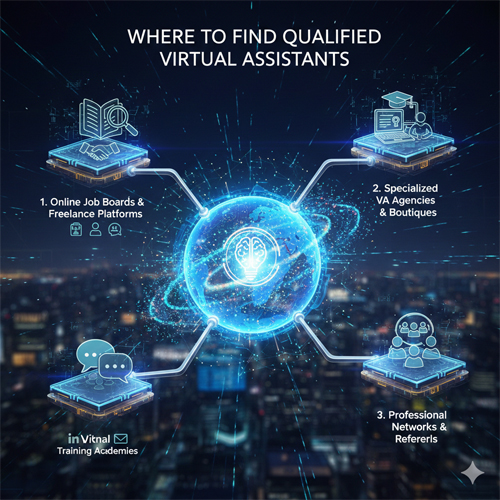
Finding candidates with strong virtual assistant qualifications requires knowing where to look:
Specialized VA Agencies
- Pros: Pre-vetted candidates, replacement guarantees, managed service
- Cons: Higher rates, less control over selection
- Examples: Belay, Time Etc, Boldly, Silkee Solutions
Freelance Marketplaces
- Pros: Large candidate pool, competitive pricing, flexible arrangements
- Cons: Variable quality, extensive vetting required, no guarantees
- Examples: Upwork, Freelancer, Fiverr, PeoplePerHour
Job Boards and Professional Networks
- Pros: Direct hire, full control, build long-term relationships
- Cons: Time-intensive screening, handle all HR aspects yourself
- Examples: LinkedIn, Indeed, FlexJobs, We Work Remotely
Referrals and Professional Networks
- Pros: Trusted recommendations, proven track records, cultural fit more likely
- Cons: Limited candidate pool, availability not guaranteed
- Approach: Ask colleagues, join entrepreneur groups, leverage business networks
Conclusion: Invest Time in Hiring Right the First Time
Understanding and evaluating virtual assistant qualifications systematically transforms hiring from guesswork into a predictable process that consistently delivers exceptional team members.
The comprehensive hiring checklist presented here covers every critical dimension of candidate assessment—from technical software proficiency to soft skills like communication and adaptability. Your thorough VA skills assessment validates claimed competencies through practical testing rather than resume claims alone.
The multi-stage screening process outlined—application review, skills testing, interviews, reference checks, and paid trials—identifies candidates who not only possess required technical abilities but also demonstrate the professional attributes and cultural fit essential for long-term success.
Yes, thorough evaluation requires time investment upfront. But this front-loaded effort prevents the exponentially higher costs of poor hires: wasted training, correcting mistakes, damaged client relationships, and starting the recruitment cycle over.
The difference between a transformative virtual assistant and a costly hiring mistake comes down to systematic qualification assessment. Use this checklist. Follow the screening process. Trust the framework. The result will be virtual team members who don’t just complete tasks but become strategic partners in your business growth.
Remember: hiring isn’t about finding someone available and affordable. It’s about identifying professionals whose qualifications, skills, and attributes align perfectly with your business needs. Take the time to hire right the first time—your future self will thank you.
Frequently Asked Questions
What are the minimum qualifications I should require for a virtual assistant?
Minimum virtual assistant qualifications should include proficiency in Google Workspace or Microsoft Office 365, typing speed of 50+ WPM at 95% accuracy, excellent written and verbal communication skills, at least 1-2 years of relevant administrative or VA experience, and demonstrated reliability through verifiable references. Additional qualifications depend on your specific needs.
How long should the VA screening process take?
A thorough screening process typically takes 2-4 weeks from initial posting to final hiring decision. This includes application review (1-3 days), skills assessment (3-5 days), initial interviews (5-7 days), reference checks (3-5 days), and a paid trial project (5-10 days). Rushing this process increases the risk of poor hires that cost far more in the long run.
What skills assessment tests should I use?
Your VA skills assessment should include typing tests (TypingTest.com), writing samples relevant to the role, software proficiency tests for platforms they’ll use daily, data entry accuracy tasks, and scenario-based questions evaluating judgment and problem-solving. Practical, task-specific tests predict performance better than general aptitude tests.
How do I evaluate soft skills during the hiring process?
Evaluate soft skills through behavioral interview questions (“Tell me about a time when…”), observing communication during all interactions, checking references specifically about reliability and work ethic, assessing their questions during interviews (demonstrates critical thinking), reviewing how they handle the application process itself, and observing professionalism throughout all touchpoints.
Should I require certifications or formal education?
Formal education is less important than demonstrated competence and experience for most VA roles. Relevant certifications (QuickBooks, specific software, project management) add value but shouldn’t be mandatory unless required for specialized tasks. Practical experience, portfolio work, and skills assessment results predict success more accurately than degrees or general certifications.
What are the biggest red flags during the screening process?
Major red flags include poor communication during the hiring process, missed deadlines for application materials or assessments, inability to provide references or provide references who give lukewarm recommendations, defensive responses to questions or feedback, excessive job-hopping without reasonable explanations, significant gaps between claimed skills and demonstrated abilities, and unprofessional behavior during any interaction.
How much should I pay a qualified virtual assistant?
Virtual assistant rates vary by experience, specialization, and location. Entry-level general VAs typically charge $15-25/hour, experienced VAs with 3-5 years $25-40/hour, and specialized VAs (bookkeeping, technical, executive-level) $40-75+/hour. US-based VAs generally cost more than international VAs. Remember that qualified professionals deliver ROI that justifies higher rates through efficiency and quality.
Should I hire a generalist or specialist VA?
Start with a versatile generalist if you have varied administrative needs across multiple areas. Hire specialists when you need deep expertise in specific domains like bookkeeping, social media, technical support, or executive assistance. Many businesses successfully combine a generalist VA for daily operations with specialists for specific functions. Your hiring checklist should reflect which type best serves your current needs.
How important is industry experience for a virtual assistant?
Industry experience accelerates productivity and reduces training time but isn’t always essential. For specialized fields (legal, medical, real estate), industry knowledge is valuable and sometimes necessary. For general administrative work, transferable skills, learning agility, and strong foundational competencies matter more than specific industry background. Include industry experience as a preference rather than a requirement unless it’s genuinely necessary.
What should I include in a paid trial project?
Design trial projects that mirror actual responsibilities: 3-5 hours of realistic work, clear instructions and deliverables, specific deadline, quality standards, and evaluation criteria. Examples include scheduling tasks in your calendar system, responding to sample customer emails, organizing a document folder, creating a presentation or report, or managing a small research project. Pay fairly at the agreed-upon rate—this demonstrates your professionalism and respect.