
The sales landscape has transformed dramatically. With remote work becoming standard and sales cycles growing increasingly complex, businesses face a critical challenge: how to scale sales operations without proportionally increasing overhead costs. Enter the virtual sales assistant a game-changing solution that’s revolutionizing how companies approach revenue generation.
A virtual sales assistant provides remote sales support, handling everything from lead generation and CRM management to appointment setting and follow-up communications. According to recent industry data, companies leveraging virtual sales assistant services report 40-60% increases in sales productivity while reducing operational costs by 30-50%.
This comprehensive guide examines everything you need to know about virtual sales assistant services in 2026—from understanding what they do and how much they cost, to hiring the right professional and calculating your potential ROI.

What is a Virtual Sales Assistant?
A virtual sales assistant is a remote professional who supports your sales team by handling administrative, operational, and sometimes frontline selling activities. Unlike traditional in-house sales staff, virtual sales assistants work remotely, providing flexible, scalable support tailored to your specific business needs.
The Modern Virtual Sales Assistant Role
Today’s virtual sales assistant goes far beyond basic administrative support. These skilled professionals serve as strategic partners in your sales operations, managing complex workflows across multiple platforms and tools.
Key characteristics of virtual sales assistants:
- Remote-first operations: Work from anywhere, providing flexibility and access to global talent
- Technology-savvy: Proficient in CRM systems (Salesforce, HubSpot, Pipedrive), communication tools, and sales automation platforms
- Sales-focused expertise: Understanding of sales processes, buyer psychology, and revenue generation strategies
- Results-oriented: Measured by outcomes like leads generated, appointments set, and pipeline value created
- Scalable support: Adjust hours and responsibilities based on business needs
Virtual Sales Assistant vs. General Virtual Assistant
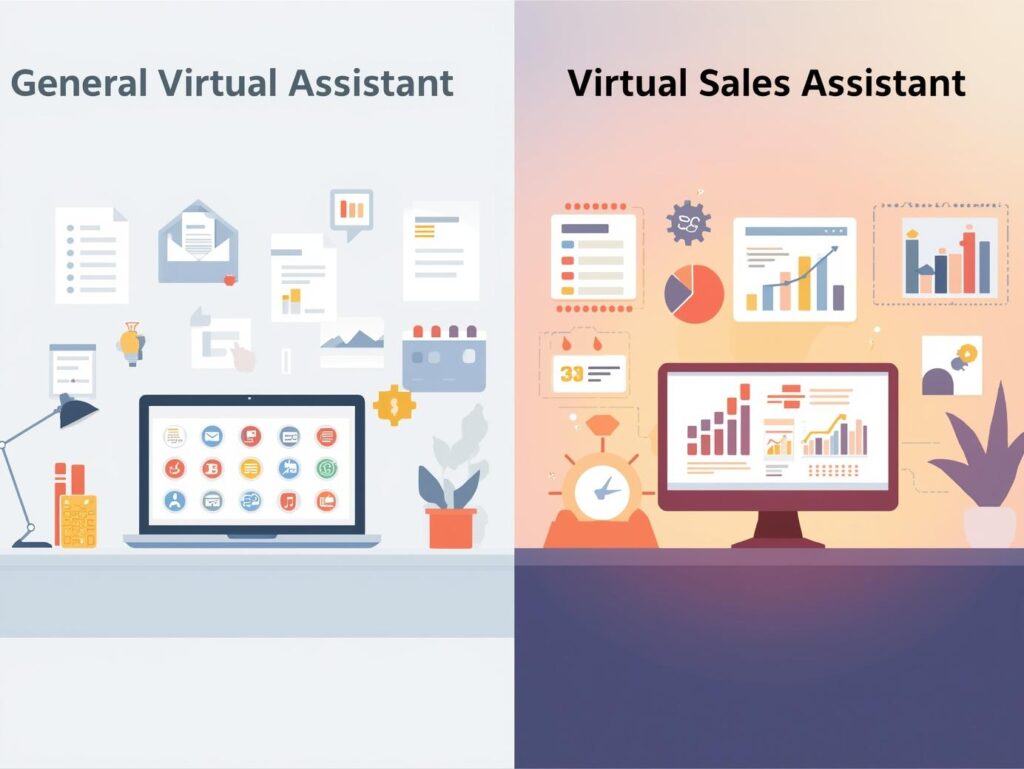
While general virtual assistants handle broad administrative tasks, virtual sales assistants specialize exclusively in revenue-generating activities. The distinction matters significantly for ROI and business impact.
General Virtual Assistant:
- Email management
- Calendar scheduling
- Travel arrangements
- General research
- Document preparation
Virtual Sales Assistant:
- Lead qualification and nurturing
- CRM data management
- Sales proposal creation
- Pipeline tracking and reporting
- Appointment setting with prospects
- Follow-up sequences
- Sales collateral management
- Quote and contract preparation
This specialization enables virtual sales assistants to deliver measurable revenue impact rather than simply saving time.
Need a sales-focused professional, not just task support? Silkee Solutions specializes in high-performing virtual sales assistants. Learn more
Why Businesses Need Virtual Sales Assistants in 2026
The business case for virtual sales assistant services has never been stronger. Multiple converging trends make 2026 the ideal time to integrate remote sales support into your operations.
The Sales Productivity Crisis
Sales professionals spend only 33% of their time actually selling, according to Salesforce’s State of Sales Report. The remaining 67% disappears into administrative tasks, data entry, internal meetings, and pipeline management.
This productivity gap costs businesses billions annually in lost opportunities. A virtual sales assistant solves this equation by reclaiming 15-20 hours weekly per sales rep, redirecting that time toward high-value client interactions.
Rising Sales Costs
The cost of maintaining traditional sales teams continues escalating:
- Average sales rep salary: $75,000-$120,000 annually
- Benefits and payroll taxes: +30-40% of salary
- Office space and equipment: $10,000-$15,000 per employee annually
- Recruiting and onboarding: $15,000-$25,000 per hire
- Sales enablement tools and training: $5,000-$10,000 annually
Virtual sales assistants provide equivalent support at 40-60% lower total cost while eliminating infrastructure expenses entirely.
The Remote Work Revolution
Remote work transitioned from experimental to essential. This shift created unprecedented opportunities to access global sales talent without geographic constraints. Companies now hire the best virtual sales assistants regardless of location, building distributed teams that operate across time zones for round-the-clock productivity.
Technology Enablement
Modern CRM platforms, sales automation tools, and communication technologies make remote sales support seamless. Cloud-based systems ensure virtual sales assistants access identical data and workflows as in-house teams, eliminating traditional remote work limitations.
Virtual Sales Assistant Impact – 2026 Data:
- 73% of companies now employ remote sales support (up from 45% in 2023)
- Average productivity increase: 42% within first 6 months
- Cost reduction vs. in-house staff: 35-50%
- Client satisfaction improvement: 28% average
- Sales cycle reduction: 18% average (Source: Virtual Sales Support Industry Report 2026)
Join the 73% of forward-thinking companies. Discover how virtual sales assistants transform sales operations. Get started
Core Responsibilities of a Virtual Sales Assistant
Understanding what virtual sales assistants actually do helps you maximize their value. While specific duties vary by industry and company, core responsibilities typically include:
Lead Generation and Prospecting
Virtual sales assistants excel at systematic prospect identification and outreach:
- Research and list building: Identifying ideal customer profiles, building targeted prospect databases
- Cold outreach: Email campaigns, LinkedIn prospecting, initial contact establishment
- Lead qualification: Screening prospects using BANT (Budget, Authority, Need, Timeline) or similar frameworks
- Appointment setting: Securing qualified meetings for senior sales representatives
- Lead nurturing: Maintaining engagement with prospects not yet ready to buy
Studies show virtual sales assistants generate 10-15 qualified leads weekly per full-time equivalent, dramatically expanding pipeline coverage.
CRM Management and Data Quality
Sales teams consistently struggle with CRM adoption and data accuracy. Virtual sales assistants solve this challenge:
- Data entry and updates: Recording all prospect/client interactions, maintaining current information
- Duplicate management: Identifying and merging redundant records
- Pipeline tracking: Monitoring deal progression, flagging stalled opportunities
- Reporting: Generating pipeline reports, forecasting dashboards, activity metrics
- System optimization: Ensuring sales team actually uses CRM through proper setup and maintenance
Companies employing virtual sales assistants for CRM management report 85% data accuracy vs. 45% industry average.
Sales Administration
Administrative tasks consume enormous sales time. Virtual sales assistants reclaim these hours:
- Proposal and quote creation: Generating professional sales documents from templates
- Contract management: Preparing agreements, tracking signatures, maintaining documentation
- Meeting coordination: Scheduling demos, presentations, and follow-up calls
- Presentation preparation: Building slide decks, assembling case studies, gathering materials
- Expense tracking: Recording sales-related expenses, managing reimbursements
Customer Communication and Follow-Up
Consistent follow-up separates successful sales operations from struggling ones. Virtual sales assistants ensure no opportunity falls through cracks:
• Post-meeting follow-up: Sending recap emails, sharing resources, scheduling next steps
• Drip campaigns: Maintaining regular touchpoints with prospects over extended sales cycles
• Customer onboarding support: Facilitating smooth transitions from prospect to customer
• Renewal reminders: Proactive outreach for subscription renewals or repeat purchases
• Survey distribution: Gathering feedback to improve sales processes
The systematic approach virtual sales assistants bring to follow-up increases conversion rates by 25-35% on average.
Sales Analytics and Reporting
Data-driven sales decisions require reliable metrics. virtual sales assistants provide:
- Activity tracking: Monitoring calls made, emails sent, meetings held
- Pipeline analysis: Conversion rates by stage, average deal size, sales velocity
- Performance dashboards: Visual reports for sales team and leadership
- Trend identification: Spotting patterns in wins, losses, and stalled deals
- Competitive intelligence: Tracking competitor mentions, win/loss analysis
Want systematic lead generation and flawless CRM management? Silkee Solutions’ virtual sales assistants deliver measurable results. See how
Benefits of Hiring a Virtual Sales Assistant
The strategic advantages of employing virtual sales assistants extend far beyond cost savings:
1. Dramatic Productivity Increases
Sales reps supported by virtual sales assistants sell 40-60% more than unsupported counterparts. This productivity surge stems from:
- More selling time: 15-20 additional hours weekly focused on revenue activities
- Better pipeline quality: Pre-qualified leads vs. cold outreach
- Improved follow-up: Systematic touchpoints preventing lost opportunities
- Enhanced preparation: Meeting-ready materials and research
2. Substantial Cost Reduction
Virtual sales assistant economics prove compelling:
Traditional Sales Rep:
- Base salary: $80,000
- Benefits (30%): $24,000
- Office/equipment: $12,000
- Total annual cost: $116,000
Virtual Sales Assistant:
- Annual cost (40 hrs/week): $45,000-$65,000
- Benefits: $0
- Infrastructure: $0
- Total annual cost: $45,000-$65,000
Savings: $51,000-$71,000 annually per position
3. Scalability and Flexibility
Virtual sales assistant arrangements adapt quickly to business changes:
- Seasonal scaling: Increase hours during busy periods, reduce during slow seasons
- Project-based work: Add capacity for specific initiatives without permanent commitments
- Geographic expansion: Enter new markets without establishing physical presence
- Risk mitigation: Test new sales strategies with minimal fixed costs
4. Access to Specialized Expertise
Virtual sales assistants often bring industry-specific experience:
- Platform expertise: Deep knowledge of specific CRMs or sales tools
- Vertical specialization: Understanding of real estate, insurance, SaaS, or other industries
- Multilingual capabilities: Supporting international sales efforts
- Technical skills: Proficiency in sales automation, data analytics, or marketing integration
5. Improved Sales Data and Insights
Virtual sales assistants focused on CRM and reporting deliver:
- Real-time visibility: Current pipeline status always accessible
- Accurate forecasting: Reliable data enabling confident predictions
- Performance transparency: Clear metrics showing what’s working
- Actionable insights: Data-backed recommendations for optimization
“Our virtual sales assistant from Silkee Solutions transformed our sales operation. She generates 20+ qualified appointments monthly, maintains our CRM flawlessly, and freed our sales team to actually sell. We’ve seen 47% revenue growth in just 8 months.”
Marcus Chen, VP Sales, TechStart Solutions
Virtual Sales Assistant vs. Traditional Sales Representative
Understanding the distinction between virtual sales assistants and traditional sales reps helps optimize your team structure:
Complementary Roles, Not Replacements
Virtual sales assistants don’t replace sales representatives—they multiply their effectiveness. Think of virtual sales assistants as force multipliers enabling reps to perform at peak capacity.
Traditional Sales Representative:
- Focus: Closing deals, strategic account management, complex negotiations
- Activities: Client meetings, demos, proposals, contract discussions
- Compensation: Base salary + commission, typically $75K-$150K+
- Best for: Relationship building, consultative selling, high-touch sales
Virtual Sales Assistant:
- Focus: Pipeline development, sales operations, administrative support
- Activities: Lead generation, CRM management, scheduling, follow-up
- Compensation: Hourly or fixed fee, typically $25-$45/hour
- Best for: Systematic processes, data management, volume activities
The Optimal Team Structure
Most successful sales organizations employ both:
Ratio recommendations:
- Early-stage companies: 1 virtual sales assistant per 2-3 sales reps
- Growth-stage companies: 1 virtual sales assistant per 3-5 sales reps
- Enterprise organizations: 1 virtual sales assistant per 5-7 reps, plus specialized virtual sales assistants for specific functions
| Factor | Virtual Sales Assistant | Traditional Sales Rep |
|---|---|---|
| Primary Role | Support & Operations | Closing & Relationships |
| Annual Cost | $45K-$65K | $100K-$200K |
| Revenue Impact | Indirect (enables closers) | Direct (closes deals) |
| Ramp Time | 2-4 weeks | 3-6 months |
| Scalability | Highly flexible | Fixed headcount |
| Location | Remote anywhere | Often office-based |
| Best Use | Volume tasks, systems | Complex sales, strategy |
How Much Does a Virtual Sales Assistant Cost?
Virtual sales assistant pricing varies based on experience, specialization, location, and engagement model:
Hourly Rate Structure
Entry-Level Virtual Sales Assistants ($20-$30/hour):
- 0-2 years sales support experience
- Basic CRM proficiency
- General administrative tasks
- Email and calendar management
- Simple lead research
- Best for: Straightforward support needs
Mid-Level Virtual Sales Assistants ($30-$45/hour):
- 2-5 years sales support experience
- Advanced CRM expertise (Salesforce, HubSpot)
- Lead generation and qualification
- Basic sales analytics
- Industry-specific knowledge
- Best for: Most business applications
Senior Virtual Sales Assistants ($45-$65/hour):
- 5+ years sales operations experience
- Strategic sales support
- Complex reporting and analysis
- Sales automation implementation
- Specialized industry expertise
- Best for: Complex sales environments
Executive Virtual Sales Assistants ($65-$100/hour):
- 7+ years enterprise sales support
- Sales operations management
- Team coordination and training
- Strategic planning involvement
- C-level interaction capability
- Best for: Enterprise organizations
Full-Time vs. Part-Time Engagement
Part-Time Virtual Sales Assistant (20 hours/week):
- Monthly cost: $1,600-$3,600
- Ideal for: Small businesses, specific projects, supplemental support
- Activities: Core tasks like CRM maintenance, basic lead gen, scheduling
Full-Time Virtual Sales Assistant (40 hours/week):
- Monthly cost: $3,200-$7,200
- Ideal for: Growing companies, comprehensive sales support
- Activities: Full sales operations support, complex workflows, strategic initiatives
Geographic Pricing Variations
US-Based Virtual Sales Assistants:
- Rate range: $35-$75/hour
- Advantages: Time zone alignment, cultural familiarity, native English
- Considerations: Higher cost, similar business hour availability
Latin America-Based Virtual Sales Assistants:
- Rate range: $20-$40/hour
- Advantages: Similar time zones, strong English skills, cost-effective
- Considerations: Minor accent variations, excellent value proposition
Philippines-Based Virtual Sales Assistants:
- Rate range: $15-$30/hour
- Advantages: Excellent English, strong work ethic, lowest cost
- Considerations: Time zone differences (12-15 hours ahead EST)
India-Based Virtual Sales Assistants:
- Rate range: $15-$35/hour
- Advantages: Technical proficiency, detailed-oriented, cost-effective
- Considerations: Accent variations, time zone differences
Agency vs. Freelance Pricing
Freelance Virtual Sales Assistants:
- Rates: $20-$60/hour direct
- Pros: Lower cost, direct relationship
- Cons: No backup coverage, quality varies, vetting burden on you
Virtual Sales Assistant Agencies (like Silkee Solutions):
- Rates: $30-$80/hour (includes agency fee)
- Pros: Pre-vetted talent, replacement guarantees, backup coverage, support infrastructure
- Cons: Slightly higher rates than freelance
Your Virtual Sales Assistant Cost Estimate:
Hours needed weekly: _ hours × Hourly rate: $_ /hour × 4.33 weeks/month = Monthly Investment: $_
Example: 30 hours/week × $35/hour × 4.33 = $4,546.50/month
Get a customized quote for your specific needs. Silkee Solutions offers transparent pricing with no hidden fees. Request proposal →
ROI Calculator: Virtual Sales Assistant Investment Returns
Calculating virtual sales assistant ROI demonstrates the financial wisdom of this investment:
Direct ROI Calculation
Time Reclaimed Value:
- Sales rep hourly value: $75-$150/hour
- Hours reclaimed weekly per rep: 15-20 hours
- Value created weekly: $1,125-$3,000
- Value created monthly: $4,875-$12,990
- Virtual sales assistant monthly cost: $3,200-$5,400
- Net monthly value: $1,675-$7,590 per supported rep
Revenue Impact Calculation
Increased Sales Productivity:
Current State:
- Sales rep closes: 15 deals/month @ $5,000 average = $75,000 monthly revenue
- Time spent selling: 35% of work hours
With Virtual Sales Assistant:
- Time spent selling increases to: 65% (nearly doubled)
- Deals closed increases to: 27 deals/month
- Monthly revenue: $135,000
- Revenue increase: $60,000/month
Assuming 10% profit margin:
- Additional profit: $6,000/month
- Virtual sales assistant cost: $4,500/month
- Net profit improvement: $1,500/month = $18,000/year
Pipeline Quality Improvement
Virtual sales assistants improving lead quality impacts conversion:
Before:
- 100 leads/month × 5% conversion = 5 deals
- Average deal size: $5,000
- Monthly revenue: $25,000
After (with qualified lead generation):
- 100 leads/month × 12% conversion = 12 deals
- Average deal size: $5,000
- Monthly revenue: $60,000
- Revenue increase: $35,000/month
Customer Retention Value
Systematic follow-up from virtual sales assistants reduces churn:
- Annual customer value: $10,000
- Customer base: 200 clients
- Churn rate before: 25%/year (50 lost customers)
- Churn rate after: 15%/year (30 lost customers)
- Customers retained: 20 additional clients
- Annual value preserved: $200,000
Average ROI Metrics for Virtual Sales Assistant Investment:
| Metric | Before | After | Improvement |
|---|---|---|---|
| Sales rep selling time | 35% | 65% | +86% |
| Monthly deals closed | 15 | 27 | +80% |
| Lead conversion rate | 5% | 12% | +140% |
| Customer retention | 75% | 85% | +13% |
| Sales cycle length | 45 days | 32 days | -29% |
Typical ROI: 300-500% within first year
Calculate your specific ROI. Silkee Solutions provides customized ROI projections based on your business metrics. Get your analysis →
Chapter 8: How to Hire the Perfect Virtual Sales Assistant
Successfully hiring a virtual sales assistant requires systematic evaluation and onboarding:
Step 1: Define Your Needs
Before hiring, clarify exactly what support you need:
Sales Process Audit:
- Which tasks consume the most sales rep time?
- What administrative burdens slow pipeline progression?
- Where do leads fall through cracks?
- Which CRM/tools need management?
- What reporting gaps exist?
Requirements Document: Create detailed specifications including:
- Required software proficiencies (Salesforce, HubSpot, etc.)
- Daily/weekly task expectations
- Industry knowledge needed
- Communication requirements
- Hours and schedule needed
- Performance metrics
- Budget constraints
Step 2: Choose Your Hiring Channel
Option A: Virtual Sales Assistant Agencies
Pros:
- Pre-vetted, trained professionals
- Replacement guarantees
- Backup coverage during absences
- Ongoing support and management
- Faster time to productivity
Recommended agencies:
- Silkee Solutions (specialized in sales support)
- Belay
- Time Etc
- Prialto
Option B: Freelance Platforms
Pros:
- Direct relationships
- Potentially lower rates
- Large candidate pools
Platforms:
- Upwork
- Freelancer.com
- OnlineJobs.ph (Philippines-specific)
Cons:
- Vetting burden on you
- No backup coverage
- Quality highly variable
Option C: Direct Hire
Pros:
- Full control
- Direct relationship
- Long-term team building
Cons:
- Time-intensive recruitment
- Payroll/HR administration
- Training responsibility
Step 3: Screen Candidates
Resume Evaluation: Look for: ✓ Specific sales support experience (not just general VA work) ✓ CRM platform expertise ✓ Industry experience relevant to your business ✓ Measurable achievements (e.g., “Managed pipeline of 500+ leads generating $2M annual revenue”) ✓ Technology proficiency ✓ Communication skills demonstrated in application
Red flags: ✗ Generic, template-style applications ✗ No sales-specific experience ✗ Vague descriptions of past work ✗ Poor written communication ✗ Unexplained employment gaps
Virtual Sales Assistant Interview Questions:
Technical Competency:
- “What CRM systems have you used extensively? Walk me through your daily CRM management workflow.”
- “How do you prioritize leads for follow-up?”
- “Describe your process for researching and qualifying prospects.”
- “What sales automation tools are you experienced with?”
- “How do you maintain data quality in a CRM?”
Sales Understanding:
- “What do you believe makes an effective sales follow-up sequence?”
- “How would you handle an angry prospect or customer?”
- “Describe the ideal qualities of a qualified lead.”
- “What metrics do you think matter most in sales support?”
- “How do you stay organized when supporting multiple sales reps?”
Problem-Solving:
- “A prospect hasn’t responded to three follow-up emails. What’s your next step?”
- “You discover significant data quality issues in the CRM. How do you address this?”
- “A sales rep asks you to prioritize conflicting urgent tasks. How do you handle it?”
Step 4: Conduct Skills Assessment
Don’t rely solely on interviews. Test actual capabilities:
CRM Test:
- Provide sample data to enter in your CRM (or a test account)
- Evaluate accuracy, speed, and attention to detail
- Assess understanding of sales stages and pipeline management
Communication Test:
- Request they draft a follow-up email to a prospect
- Evaluate professionalism, clarity, and persuasive ability
Research Test:
- Ask them to identify 10 qualified leads for your business
- Assess research methodology and lead quality
Organization Test:
- Present a complex scenario with multiple priorities
- Evaluate how they structure and approach the work
Step 5: Start with a Trial Period
Never commit long-term immediately:
2-Week Trial Structure:
- Week 1: Basic tasks (CRM data entry, scheduling, research)
- Week 2: More complex work (lead generation, reporting, proposal prep)
- Evaluation checkpoints at day 3, 7, and 14
- Clear performance metrics established upfront
Trial success indicators: ✓ Consistent quality and accuracy ✓ Proactive communication ✓ Quick learning curve ✓ Positive chemistry with sales team ✓ Meeting deadlines reliably
Step 6: Comprehensive Onboarding
Successful virtual sales assistant integration requires investment:
Week 1-2: Foundation
- Company and product training
- CRM system access and training
- Tool stack orientation
- Sales process documentation
- Team introductions
- Initial task assignments
Week 3-4: Skill Development
- Shadow sales calls/meetings
- Advanced CRM training
- Industry-specific education
- Process refinement based on learnings
- Increasing responsibility
Week 5-8: Independence
- Full task ownership
- Performance monitoring
- Regular feedback sessions
- Process optimization
- Goal setting for ongoing performance
Virtual Sales Assistant Hiring Checklist:
☐ Define specific role requirements ☐ Create detailed job description ☐ Choose hiring channel (agency vs. freelance) ☐ Screen minimum 5-10 candidates ☐ Conduct video interviews (minimum 2 rounds) ☐ Complete skills assessment ☐ Check references (minimum 2-3) ☐ Start with trial period (2-4 weeks) ☐ Develop onboarding documentation ☐ Set clear performance metrics ☐ Schedule regular check-ins ☐ Provide ongoing training and feedback
Skip the hiring hassle. Silkee Solutions provides pre-vetted, sales-specialized virtual assistants matched to your needs. Start your risk-free trial
Virtual Sales Assistant Success Stories
Real-world examples demonstrate virtual sales assistant impact:
Case Study 1: SaaS Startup 3X’s Revenue
Company: CloudMetrics (B2B analytics platform) Challenge: Two-person sales team overwhelmed with lead follow-up and administrative tasks
Solution: Hired one full-time virtual sales assistant from Silkee Solutions
Results (12 months):
- Monthly qualified appointments: Increased from 12 to 38 (+217%)
- Sales cycle length: Decreased from 62 to 41 days (-34%)
- CRM data accuracy: Improved from 43% to 94%
- Sales rep selling time: Increased from 30% to 68%
- Revenue: Grew from $45K/month to $142K/month (+216%)
ROI: $65,000 invested in virtual sales assistant, $1.16M additional revenue generated = 1,685% ROI
Case Study 2: Real Estate Team Doubles Transactions
Company: Premier Properties Group Challenge: Managing 300+ active leads across 4 agents, inconsistent follow-up
Solution: Implemented two part-time virtual sales assistants (20 hours each weekly)
Results (6 months):
- Lead response time: Improved from 4.2 hours to 18 minutes
- Conversion rate: Increased from 1.8% to 4.3%
- Transactions closed: Increased from 3.2/month to 6.7/month per agent
- Client satisfaction: Improved from 7.2/10 to 9.1/10
- Agent stress levels: Reduced by 67% (reported)
ROI: $28,000 invested, $340,000 additional commission revenue = 1,114% ROI
Case Study 3: Manufacturing Company Expands Territory
Company: IndustrialTech Solutions Challenge: Wanted to expand into new geographic market without hiring local sales rep
Solution: Hired virtual sales assistant specializing in their industry
Results (9 months):
- New market prospects identified: 284 qualified companies
- Appointments set: 47
- Deals closed: 12
- Revenue from new market: $680,000
- Cost of market entry: $42,000 (virtual sales assistant + marketing)
ROI: Traditional approach would have cost $150,000+ (salary, travel, office setup) = $108,000 saved, plus $680,000 revenue generated
“We were skeptical about hiring a virtual sales assistant. After 90 days, our VA had become indispensable. She knows our CRM better than we do, generates consistently qualified leads, and freed us to focus on what we’re great at—closing deals. Best business decision we’ve made.”
— Jennifer Martinez, Founder & CEO, NextGen Consulting
Frequently Asked Questions About Virtual Sales Assistants
What tasks can a virtual sales assistant legally handle?
Virtual sales assistants can handle extensive sales support tasks, but compliance varies by industry. Generally permissible:
✓ Lead research and list building ✓ Initial prospect outreach (email, LinkedIn) ✓ CRM data management ✓ Appointment scheduling ✓ Follow-up communications ✓ Proposal and quote preparation ✓ Sales reporting and analytics ✓ Administrative support
Restrictions (typically require licensed sales professionals): ✗ Making binding commitments/contracts ✗ Providing professional advice (insurance, financial services) ✗ Negotiating terms (in some industries) ✗ Representing themselves as company employees (if they’re contractors)
Always consult legal counsel for industry-specific compliance requirements.
How quickly can a virtual sales assistant become productive?
Timeline expectations:
Week 1-2: Learning phase
- Understanding company, products, sales process
- CRM and tool training
- Initial basic tasks
- Productivity: 20-30%
Week 3-4: Ramp-up phase
- Increasing task complexity
- Building independence
- Process refinement
- Productivity: 50-60%
Week 5-8: Working phase
- Full task ownership
- Proactive problem-solving
- Optimizing workflows
- Productivity: 80-90%
Month 3+: Peak performance
- Deep company knowledge
- Strategic contributions
- Process innovation
- Productivity: 100%+
Virtual sales assistants with prior industry experience reach productivity 30-40% faster than those new to your sector.
Can virtual sales assistants work with our existing CRM?
Yes. Professional virtual sales assistants work with all major CRM platforms:
• Salesforce (all editions) • HubSpot CRM • Pipedrive • Zoho CRM • Microsoft Dynamics 365 • Copper (formerly ProsperWorks) • Close.io • Freshsales • Insightly • Custom/proprietary systems (with training)
Experienced virtual sales assistants typically achieve proficiency in unfamiliar CRMs within 1-2 weeks with proper training and documentation.
What’s the difference between a virtual sales assistant and an SDR?
Sales Development Representative (SDR):
- Employee position (W-2)
- Full-time, dedicated to one company
- Quota-carrying role
- Focuses exclusively on outbound prospecting
- Career path toward Account Executive
- Compensation: $50K-$80K base + commission
- Reports directly to sales management
Virtual Sales Assistant:
- Contractor or agency relationship (1099)
- May be part-time or full-time
- Non-quota carrying support role
- Handles diverse sales operations tasks
- Career path in sales operations/support
- Compensation: Hourly or fixed fee ($45K-$70K for full-time)
- Supports multiple sales team members
SDRs hunt deals; virtual sales assistants support hunters.
How do we ensure data security with a virtual sales assistant?
Implement these security protocols:
Access Controls: • Role-based CRM permissions (limit to necessary data) • Separate login credentials (never share passwords) • Multi-factor authentication required • Regular access reviews and updates • Immediate access removal upon termination
Legal Protections: • Signed Non-Disclosure Agreement (NDA) • Data Protection Agreement • Confidentiality clauses in contract • Clear data handling policies • Compliance with GDPR/CCPA if applicable
Technical Safeguards: • VPN requirements for system access • Encrypted communication channels • Secure password management tools • Monitoring of data access/downloads • Regular security training
Reputable virtual sales assistant agencies like Silkee Solutions include comprehensive security protocols and insurance coverage.
What if the virtual sales assistant doesn’t work out?
Quality agencies provide safety nets:
Replacement Guarantees:
- Most agencies offer free replacement within 30-90 days
- No additional fees for finding better fit
- Quick turnaround (typically 1-2 weeks)
Trial Periods:
- Start with 2-4 week trial before long-term commitment
- Evaluate fit and performance with minimal risk
- Clearly defined trial success metrics
Flexible Agreements:
- Month-to-month or quarterly contracts (avoid long-term lock-ins)
- Scaling options (increase/decrease hours as needed)
- Pause options for business fluctuations
Performance Reviews:
- Regular check-ins (weekly in early months)
- Clear feedback mechanisms
- Course correction opportunities
- Documented performance expectations
Freelance virtual sales assistants may not offer these protections—a key agency advantage.
Can virtual sales assistants handle calls with prospects and clients?
Absolutely. Many virtual sales assistants excel at phone-based tasks:
Common phone responsibilities: • Appointment setting and scheduling • Qualification calls (BANT assessment) • Follow-up calls after proposals sent • Customer service and support inquiries • Survey and feedback collection • Event registration and coordination
Best practices: • Provide call scripts and talk tracks • Use call recording for training/quality • Establish clear escalation protocols • Define which calls VA handles vs. sales rep • Consider voice quality and accent comprehension • Use VoIP systems (RingCentral, Zoom Phone) for seamless integration
Some virtual sales assistants specialize in phone work; verify this capability during hiring if important to your needs.
How do we measure virtual sales assistant performance?
Track both activity and outcome metrics:
Activity Metrics (Leading Indicators): • Leads researched/qualified weekly • Outreach emails sent • Appointments scheduled • CRM records updated • Follow-ups completed • Proposals/quotes generated
Outcome Metrics (Lagging Indicators): • Qualified appointments that show up • Lead-to-opportunity conversion rate • Opportunities sourced by VA that close • CRM data accuracy percentage • Sales rep time freed up (hours/week) • Pipeline value generated
Quality Metrics: • Accuracy of data entry • Timeliness of task completion • Communication responsiveness • Proactive problem identification • Process improvement suggestions
ROI Metrics: • Revenue attributable to VA support • Cost per qualified lead • Cost per appointment set • Sales productivity improvement • Overall return on investment
Establish baseline metrics before hiring, then track improvements monthly. Most successful companies conduct formal quarterly reviews with virtual sales assistants.
What happens if our virtual sales assistant gets sick or takes vacation?
Coverage strategies:
Agency Model (Recommended):
- Backup VA coverage during absences
- Cross-training within agency team
- Documented processes enable seamless handoffs
- No gap in support
Freelance Model:
- Request advance notice (2-4 weeks minimum)
- Build process documentation for coverage
- Consider having backup VA relationships
- Accept some service interruption
Best Practices: • Document all processes and workflows • Maintain updated task lists and priorities • Store all work in shared systems (not local files) • Build in redundancy for critical tasks • Schedule planned absences during slower periods
Should we hire locally or offshore for virtual sales assistant support?
Consider these factors:
US-Based Virtual Sales Assistants:
Pros: ✓ Perfect time zone alignment ✓ Cultural familiarity ✓ Native English (typically) ✓ Easier communication ✓ Similar business hours
Cons: ✗ Higher cost ($35-$75/hour) ✗ Smaller talent pool
Best for: Companies requiring significant phone work, complex communication, or have budget flexibility
Offshore Virtual Sales Assistants (Philippines, Latin America, India):
Pros: ✓ Cost-effective ($15-$40/hour) ✓ Large talent pools ✓ Strong work ethic ✓ Excellent English (especially Philippines) ✓ Time zone coverage (can work your off-hours)
Cons: ✗ Potential time zone challenges ✗ Minor accent/communication variations ✗ Cultural differences requiring management
Best for: Budget-conscious companies, tasks not requiring extensive phone work, businesses wanting 24/7 coverage
Hybrid Approach: Many companies use US-based virtual sales assistants for phone-heavy roles and offshore VAs for CRM management and administrative tasks.
Still have questions? Schedule a free consultation with Silkee Solutions to discuss your specific virtual sales assistant needs. Get answers from experts
The virtual sales assistant revolution is here. As we’ve explored throughout this comprehensive guide, virtual sales assistants deliver measurable, transformative impact on sales operations—from reclaiming 15-20 hours weekly per sales rep to generating 40-60% productivity increases and 300-500% ROI within the first year.
Whether you’re a solo entrepreneur managing your first sales pipeline or a sales leader managing a distributed team, virtual sales assistant support provides the leverage needed to scale revenue without proportionally scaling costs. The businesses thriving in 2026 aren’t working harder—they’re working smarter by deploying specialized remote talent focused exclusively on revenue-generating activities.
The question isn’t whether to leverage virtual sales assistant services. It’s how quickly you can implement this competitive advantage while your competitors continue struggling with administrative burdens and productivity gaps.
Start small if needed—even part-time virtual sales assistant support delivers immediate value. Test the model, measure results, then scale as ROI proves itself. The case studies and data throughout this guide demonstrate consistent patterns: companies that embrace virtual sales assistant support outperform those that don’t.
Your sales team possesses valuable skills and relationships. Free them from administrative chaos. Let virtual sales assistants handle the systems, data, and processes while your closers focus on what they do best—building relationships and closing deals.
The future of sales is remote, distributed, and powered by specialized virtual talent. The future is now.
Ready to Transform Your Sales Operation?
Silkee Solutions specializes in matching businesses with high-performing virtual sales assistants who deliver measurable results from day one.
✓ Pre-vetted, sales-specialized professionals ✓ Risk-free trial period ✓ Replacement guarantee ✓ Transparent pricing ✓ Dedicated account management ✓ Proven track record (500+ successful placements)
Don’t let administrative tasks limit your sales potential. Discover how a virtual sales assistant can multiply your revenue while reducing costs.