
The landscape of remote work has evolved dramatically, and managing remote virtual assistant teams effectively has become a mission-critical skill for business leaders. With 74% of companies planning to permanently adopt hybrid or fully remote models in 2026, understanding advanced strategies for remote team communication, performance tracking, and virtual collaboration separates thriving businesses from those struggling with productivity challenges.
This comprehensive guide presents cutting-edge best practices specifically designed for 2026, incorporating the latest tools, methodologies, and insights from successful remote-first organizations. Whether you’re new to managing remote virtual assistant professionals or looking to optimize existing remote workflows, these strategies will help you build high-performing virtual teams that deliver exceptional results.
The Foundation: Setting Up for Remote Management Success

Before diving into daily management tactics, establishing the right foundation is essential for managing remote virtual assistant teams effectively. This groundwork determines whether your remote operations run smoothly or constantly encounter friction.
Define Clear Roles and Responsibilities
Ambiguity destroys remote team productivity. Create detailed documentation covering:
- Core responsibilities – Specific tasks and deliverables expected from each VA
- Decision-making authority – What they can decide independently vs. what requires approval
- Success metrics – Quantifiable standards for evaluating performance
- Communication protocols – When, how, and through which channels to communicate
- Growth pathways – How their role can evolve over time
This clarity prevents the most common remote management pitfalls: duplicated effort, missed tasks, and constant requests for direction.
Build Your Remote Management Tech Stack
Successful virtual collaboration requires intentional tool selection. The 2026 optimal stack includes:
Communication Platforms:
- Async messaging – Slack, Microsoft Teams, or Discord for quick updates
- Video conferencing – Zoom, Google Meet, or Teams for face-to-face connection
- Async video – Loom or Vidyard for recorded instructions and feedback
- Email – Reserved for formal communications and external correspondence
Project Management & Task Tracking:
- Asana, Monday.com, or ClickUp – Visual task boards with dependencies and timelines
- Notion or Confluence – Centralized documentation and knowledge base
- Time tracking – Toggl, Harvest, or Time Doctor (used ethically for insights, not surveillance)
Performance Tracking:
- Goal-setting frameworks – Lattice, 15Five, or built-in project management OKRs
- Analytics dashboards – Custom dashboards tracking key metrics specific to VA roles
- Quality assurance tools – Grammarly for writing, CheckMarket for customer satisfaction
Critical principle: Choose fewer tools used consistently over many tools used sporadically. Tool sprawl creates confusion and reduces remote team communication efficiency.
Establish Working Agreements
Create a team charter documenting:
- Core working hours – Overlap periods when everyone is available
- Response time expectations – Different SLAs for urgent vs. routine communications
- Meeting norms – Camera expectations, preparation requirements, punctuality standards
- Communication preferences – Which channel for which type of message
- Escalation paths – How to flag genuine emergencies
These agreements prevent misunderstandings and create psychological safety in remote environments where casual clarification opportunities don’t exist.
Mastering Remote Team Communication
Effective remote team communication is the single most important factor in managing remote virtual assistant teams successfully. Without it, even the most talented VAs struggle. With it, average performers become exceptional.
The Synchronous vs. Asynchronous Balance
Synchronous communication (real-time) should comprise only 20-30% of your remote interactions. Reserve it for:
- Complex problem-solving requiring back-and-forth discussion
- Relationship building and team connection
- Sensitive feedback or difficult conversations
- Strategic planning and brainstorming sessions
- Onboarding and training for new team members
Asynchronous communication should handle the remaining 70-80%:
- Task assignments and project updates
- Process documentation and SOPs
- Routine feedback on completed work
- Information sharing and announcements
- Non-urgent questions and clarifications
Async-first approaches respect time zones, reduce meeting fatigue, create automatic documentation, and allow thoughtful responses. This is essential for effective virtual collaboration.
The 5-15 Communication Framework
Implement this proven structure for managing remote virtual assistant teams:
Daily 5-Minute Check-ins (Async)
Each VA posts a brief update answering:
- What I completed yesterday
- What I’m working on today
- Any blockers or questions
Post in a dedicated Slack channel or project management tool. Keeps everyone aligned without interrupting flow.
Weekly 15-Minute Syncs (Live)
Brief video calls covering:
- Progress on major initiatives
- Upcoming priorities for next week
- Quick wins and challenges
- Personal connection and team bonding
This framework provides structure without micromanagement and maintains connection without meeting overload.
Over-Communication as Default
In remote environments, err on the side of over-communicating:
- Provide context – Don’t assume VAs know why tasks matter
- Acknowledge receipt – Confirm you’ve received their updates or deliverables
- Surface assumptions – Make implicit expectations explicit
- Share reasoning – Explain the ‘why’ behind decisions
- Document verbally – Follow up important verbal discussions with written summaries
What feels like over-communication in person is usually just-right communication remotely.
Implementing Effective Performance Tracking

Strategic performance tracking balances accountability with autonomy when managing remote virtual assistant teams. The goal isn’t surveillance—it’s clarity, growth, and mutual success.
The OKR Framework for Virtual Assistants
Objectives and Key Results (OKRs) provide structure without rigidity:
Quarterly Objectives (2-3 per VA):
Big-picture goals aligned with business priorities. Example: ‘Improve customer support response quality and efficiency.’
Key Results (3-5 per objective):
Measurable outcomes proving objective achievement:
- Reduce average response time from 4 hours to 2 hours
- Increase customer satisfaction score from 4.2 to 4.7
- Resolve 95% of inquiries on first contact
- Process 50 tickets daily while maintaining quality standards
Review progress monthly, adjust if needed, and celebrate wins. This approach creates shared ownership of results.
Leading vs. Lagging Indicators
Track both types for comprehensive performance tracking:
Lagging Indicators (outcome metrics):
- Tasks completed on time
- Customer satisfaction scores
- Error rates and quality metrics
- Revenue generated or costs saved
Leading Indicators (activity metrics predicting outcomes):
- Response time to inquiries
- Proactive communication frequency
- Process improvement suggestions submitted
- Skills developed through training
Leading indicators allow course-correction before problems affect results. Lagging indicators validate whether strategies work.
Quality Over Quantity Metrics
Avoid the trap of measuring only activity. Track outcomes:
Poor metric: Number of emails sent
Better metric: Percentage of customer issues resolved without escalation
Poor metric: Hours logged
Better metric: Project milestones completed on schedule
Poor metric: Social media posts published
Better metric: Engagement rate and follower growth
Measuring business impact, not busy-ness, drives meaningful performance tracking.
The Monthly Performance Review Structure
Conduct structured monthly reviews covering:
- Metric review (10 minutes) – Discuss OKR progress and KPI trends
- Wins celebration (5 minutes) – Acknowledge achievements and growth
- Challenge discussion (10 minutes) – Collaborative problem-solving for obstacles
- Development planning (10 minutes) – Skills to build, training opportunities
- Feedback exchange (5 minutes) – Two-way feedback on what’s working/not working
Document these conversations and track progress over time to identify patterns and growth trajectories.
Optimizing Virtual Collaboration
Effective virtual collaboration transforms isolated remote workers into cohesive teams when managing remote virtual assistant professionals. These practices build connection, alignment, and shared purpose.
The Documentation-First Approach
Build a culture where documentation is automatic:
- Written > Verbal – Default to written communication for decisions and instructions
- Single source of truth – Maintain one central knowledge base (Notion, Confluence)
- Living documentation – Encourage VAs to update docs when they find gaps
- Video SOPs – Create Loom recordings for complex processes
- Meeting notes template – Standardize how meetings are documented
Good documentation eliminates repeated questions, enables self-service problem-solving, and creates institutional knowledge that survives team transitions.
Cross-Functional Collaboration Systems
When multiple VAs work on interconnected tasks:
- Shared visibility – Everyone sees relevant task progress in project management tools
- Dependency mapping – Link related tasks so VAs know their blockers and dependencies
- Handoff protocols – Clear standards for passing work between team members
- Collaboration channels – Dedicated Slack channels for specific projects or functions
- Peer review systems – VAs review each other’s work before final submission
These systems prevent silos and foster teamwork despite physical distance.
Building Remote Team Culture
Virtual assistants perform better when they feel connected:
Regular Team Rituals:
- Monthly virtual coffee chats (informal, no agenda)
- Quarterly team celebrations recognizing achievements
- Peer recognition programs (kudos channels)
- Virtual team-building activities (trivia, games, challenges)
Personal Connection:
- Start meetings with personal check-ins
- Remember and acknowledge birthdays, work anniversaries
- Create space for non-work conversation
- Send personalized thank-you messages for exceptional work
Culture isn’t an accident—it requires intentional design in remote environments.
2026 Trends in Remote VA Management
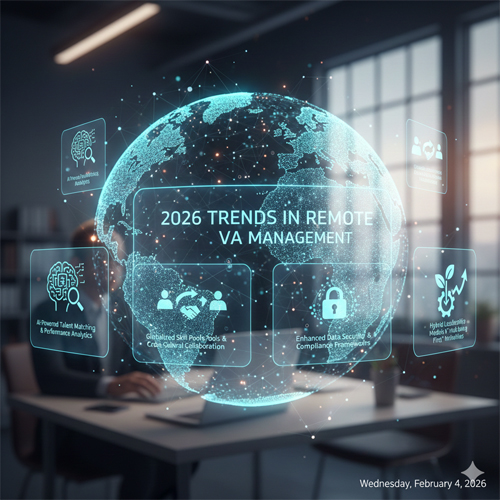
Stay ahead of the curve with these emerging best practices for managing remote virtual assistant teams:
AI-Augmented VA Work
Virtual assistants increasingly leverage AI tools:
- AI writing assistants – Grammarly, Claude, ChatGPT for content drafting
- Smart scheduling – AI-powered calendar optimization
- Automated workflows – Zapier, Make integrations reducing manual tasks
- Customer service AI – Chatbots handling tier-1 support, VAs managing complex cases
Top-performing VAs multiply their impact through strategic AI adoption. Provide training and guidelines for ethical, effective AI use.
Results-Only Work Environments (ROWE)
Progressive organizations abandon time-tracking for outcome-based management:
- No required hours—only required results
- Focus on deliverables, not activity
- Trust-based flexibility around when and where work happens
- Clear expectations with complete autonomy on execution
This approach attracts and retains top talent while dramatically improving satisfaction and performance.
Specialized VA Roles
The VA industry continues specializing:
- Executive VAs handling C-suite support
- Technical VAs managing software/SaaS administration
- Industry-specific VAs (legal, medical, real estate)
- Project management VAs coordinating complex initiatives
- Growth VAs focused on marketing and business development
Match VA specializations to your specific needs for maximum value.
Common Pitfalls to Avoid
Even experienced managers make these mistakes when managing remote virtual assistant teams:
Pitfall 1: Micromanagement Through Surveillance
Using invasive monitoring tools destroys trust and morale. Focus on performance tracking outputs, not inputs. Judge VAs on results delivered, not hours logged or keystrokes typed.
Pitfall 2: Insufficient Onboarding
Rushing onboarding guarantees underperformance. Invest 2-4 weeks in comprehensive training covering tools, processes, expectations, and culture. The upfront time investment pays dividends through faster productivity and fewer errors.
Pitfall 3: Communication Vacuum
Silence creates anxiety. Provide regular feedback—both positive reinforcement and constructive guidance. Weekly check-ins prevent small issues from becoming major problems. Effective remote team communication requires intentional overcommunication.
Pitfall 4: One-Size-Fits-All Management
Different VAs need different approaches. Adapt your management style to individual preferences, experience levels, and working styles. Some thrive with autonomy; others need more structure. Flexibility demonstrates respect and improves performance.
Pitfall 5: Neglecting Professional Development
VAs who feel stagnant leave. Invest in training, provide growth opportunities, expand responsibilities over time, and discuss career pathways. Development-focused cultures attract and retain exceptional talent.
Partner with Silkee Solutions for Expert Virtual Assistant Services
While mastering managing remote virtual assistant teams takes time and practice, you don’t have to navigate it alone. Silkee Solutions provides pre-vetted, highly skilled virtual assistants who already understand best practices for remote team communication, virtual collaboration, and professional excellence.
Why Choose Silkee Solutions:
- Rigorously vetted talent – Only the top 3% of applicants join our team
- Specialized expertise – Match with VAs experienced in your industry and needs
- Seamless onboarding – We handle recruitment, screening, and initial training
- Built-in accountability – Structured performance tracking and quality assurance
- Flexible scaling – Easily adjust hours and responsibilities as needs evolve
- Replacement guarantee – If fit isn’t right, we find you a better match at no cost
- Comprehensive support services – Administrative, customer service, social media, bookkeeping, and more
Our virtual assistants come equipped with the tools, training, and professional habits that make managing remote virtual assistant teams effortless. They understand remote team communication best practices, proactively track their own performance, and excel at virtual collaboration.
Visit https://silkeesolutions.com to learn how Silkee Solutions can provide the remote virtual assistant support your business needs to thrive in 2026 and beyond.
Conclusion: Building Remote Management Excellence
Successfully managing remote virtual assistant teams in 2026 requires intentional systems, clear communication, and continuous improvement. The frameworks presented here—from establishing foundations to implementing performance tracking, optimizing remote team communication, and fostering virtual collaboration—create the structure high-performing remote teams need to excel.
The shift to remote work isn’t temporary—it’s the future. Organizations that master remote management gain competitive advantages through access to global talent, reduced overhead, and scalable operations. Those that cling to outdated in-office management approaches will struggle to attract and retain top virtual assistants.
Start implementing these best practices today. Begin with one area—perhaps improving your remote team communication cadence or implementing structured performance tracking. Master that, then add another. Incremental improvements compound into transformative results.
Remember: managing remote virtual assistant teams effectively isn’t about controlling from a distance. It’s about creating environments where talented professionals thrive, delivering exceptional work while maintaining work-life balance and professional growth.
The remote work revolution empowers you to build teams unconstrained by geography, accessing the best talent worldwide. Embrace these 2026 best practices, and transform your virtual assistant relationships from transactional arrangements into strategic partnerships driving business success.
Frequently Asked Questions
What are the most important skills for managing remote virtual assistants?
The most critical skills for managing remote virtual assistant teams include clear written communication, ability to set measurable expectations, comfort with asynchronous workflows, trust-based delegation, and proficiency with remote collaboration tools. Managers must also develop cultural sensitivity when working with global teams and maintain consistent communication rhythms without micromanaging.
How often should I communicate with my remote virtual assistant?
Implement daily async check-ins (5-minute status updates) and weekly 15-minute live video syncs. For new VAs, increase frequency with additional touch points during the first month. Established high performers may need less frequent check-ins. Adjust based on individual needs, project complexity, and performance levels. The key is consistency and predictability in your remote team communication.
What metrics should I track for virtual assistant performance?
Track both outcome metrics (task completion rate, quality scores, customer satisfaction, deadline adherence) and leading indicators (response times, proactive communications, process improvements suggested). Use OKRs for quarterly goal-setting and KPIs for ongoing performance tracking. Focus on business impact rather than activity metrics like hours logged. Each VA role requires customized metrics aligned with their specific responsibilities.
How can I build team culture with remote virtual assistants?
Create intentional connection opportunities through monthly informal video coffee chats, quarterly team celebrations, peer recognition programs, and virtual team-building activities. Start meetings with personal check-ins, acknowledge milestones and achievements, and foster async community through dedicated social channels. Virtual collaboration thrives when you invest in relationship building beyond transactional task management.
What tools are essential for managing remote virtual assistants in 2026?
Essential tools include project management platforms (Asana, Monday.com, ClickUp), async messaging (Slack, Microsoft Teams), video conferencing (Zoom, Google Meet), documentation hubs (Notion, Confluence), and async video (Loom). Add time tracking (Toggl, Harvest) and performance management tools (Lattice, 15Five) as needed. Choose fewer tools used consistently rather than many tools used sporadically to avoid fragmentation in your remote team communication.
How do I handle time zone differences with remote virtual assistants?
Establish core overlap hours when everyone is available for synchronous communication, typically 2-4 hours daily. Embrace async-first communication for most interactions, using video recordings and detailed written updates. Rotate meeting times if overlap is limited to share the inconvenience fairly. Use world clock tools and clearly communicate deadlines in specific time zones. Consider hiring VAs in compatible time zones if synchronous collaboration is essential.
What is the best way to provide feedback to remote virtual assistants?
Provide feedback promptly (within 24-48 hours), specifically (with concrete examples), and constructively (focused on improvement). Use the SBI model: Situation, Behavior, Impact. Balance corrective feedback with recognition of strengths. Deliver sensitive feedback via video call for tone and nuance; routine feedback can be async. Document feedback conversations and track progress over time. Make feedback a regular part of performance tracking rather than rare formal events.
How can I prevent my remote virtual assistant from feeling isolated?
Combat isolation through regular one-on-ones, team meetings with video on, informal connection opportunities, peer collaboration on projects, recognition programs, and inclusion in company updates. Encourage VAs to connect directly with each other, not just through you. Create dedicated channels for non-work conversation. Invest in annual or biannual in-person meetups if budget allows. Virtual collaboration works best when relationship building is prioritized alongside task completion.
Should I use time tracking software when managing remote virtual assistants?
Use time tracking ethically for insights, not surveillance. It helps identify workflow inefficiencies, estimate project timelines, and allocate resources. However, focus performance tracking on outcomes and results, not hours logged. For salaried or project-based VAs, trust-based management without time tracking often yields better results. If using time tracking, be transparent about its purpose and never use it punitively. Results-only work environments (ROWE) are increasingly replacing time-based management.
What are the signs that my remote virtual assistant management approach isn’t working? Warning signs include consistently missed deadlines, declining quality of work, decreased communication frequency, repeated questions about previously covered topics, lack of initiative or proactivity, high turnover, complaints about unclear expectations, and VAs expressing frustration or disengagement. These indicate problems with communication clarity, performance tracking systems, training adequacy, or cultural fit. Address issues promptly through honest conversations and systematic improvements to your r