
Small business owners wear too many hats. Administrative work accumulates and steals your attention in between serving your clients, managing the finances of the business and planning for growth. That’s when a virtual assistant for small business administrative support come into play.
Research indicates small business owners invest almost 40% of their time on non-revenue generating administrative tasks. Picture getting back all those hours to spend on things that really make your business grow. All that is thanks to your virtual assistants, who are taking all those small tasks like scheduling and planning, away from you so that you can finally focus on building your dream.
What Is a Virtual Assistant for Small Business Administrative Support?
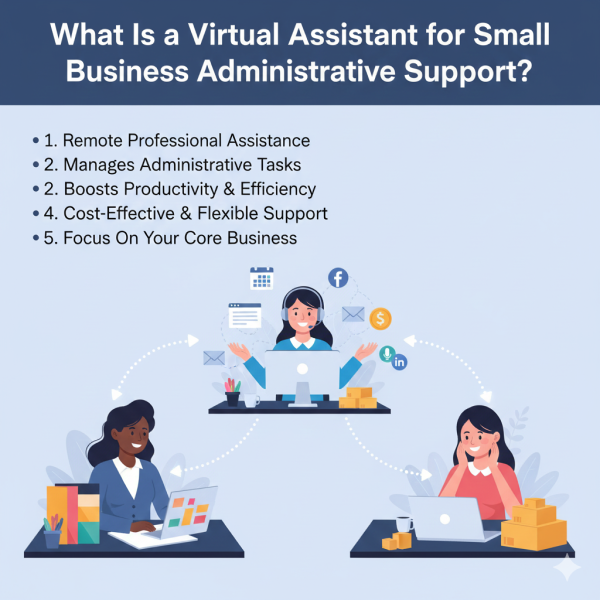
A virtual assistant for small business administrative support is a trained remote worker who carries out your business operations from their own place of work. Handling anything from emails and scheduling to data entry and customer service, they can free up time for you to manage your business strategically.
Virtual assistants are not employees in the traditional sense; they work from a distance, utilizing their own office space and computer equipment. You get to pay for only as many hours you use worry-free of office space, equipment, benefits and payroll taxes! This kind of flexibility makes them a great solution for small businesses that require help from friends without the commitment of full-time employees.
They have strong and deep industry expertise. A lot of them have worked with 50 or even 100 companies, they’ve seen what works and can put in place proven strategies from the get-go. You’re not just hiring a pair of hands to take orders — you’re getting an informed partner who helps make your business run better.
Why Small Businesses Need Administrative Virtual Assistant Services
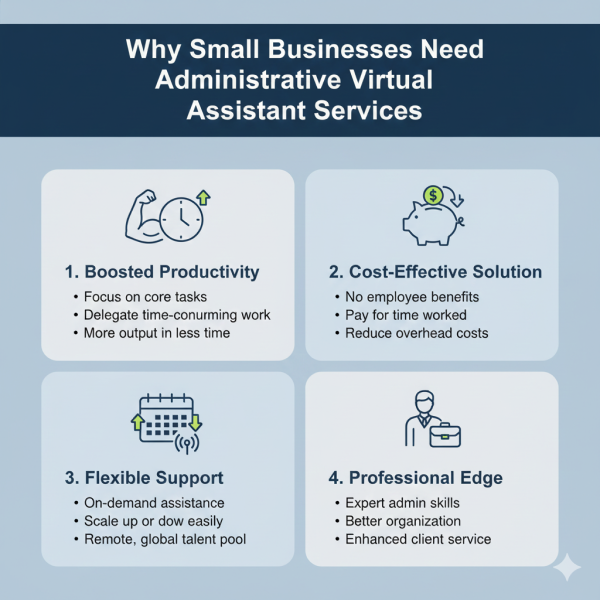
The numbers paint a clear picture. Small business owners who outsource administrative burdens grow faster and avoid burnout. Here’s why administrative support matters:
Spend Time on Revenue-Generating Activities: If you’re making a lot of money, every hour counting pennies is an hour not focusing on selling, producing or nurturing relationships. Virtual assistants do the behind-the-scenes work and allow you to concentrate on things that make money.
Professional Management for a Fraction of the Full-Time Cost: Employing just one full-time administrative assistant amounts to $35,000-$50,000 per year plus benefits and taxes. A virtual assistant for admin tasks for some small businesses can be the same great value at A thread of the cost — perhaps $1,000 to $3,000 month to month for part-time support.
Scalable Grow With You: Your requirements are not the same from month to month. Virtual assistants grow with you adding hours in the busy season and subtracting them when things quiet down. No uncomfortable layoff conversations, and no underemployed staff during slow seasons.
Different Skills: You’re not stuck with a jack of all trades. Need bookkeeping help? Find someone with accounting experience. Need customer service? Find someone with a service background.
Less Stress, Better Work-Life Balance: Quit working nights and weekends to catch up on administrative work. Your business won’t fall apart if someone else is in charge of these things, and it means you can take days off for real.
Core Services: What Does a Virtual Administrative Assistant for Small Business Handle?
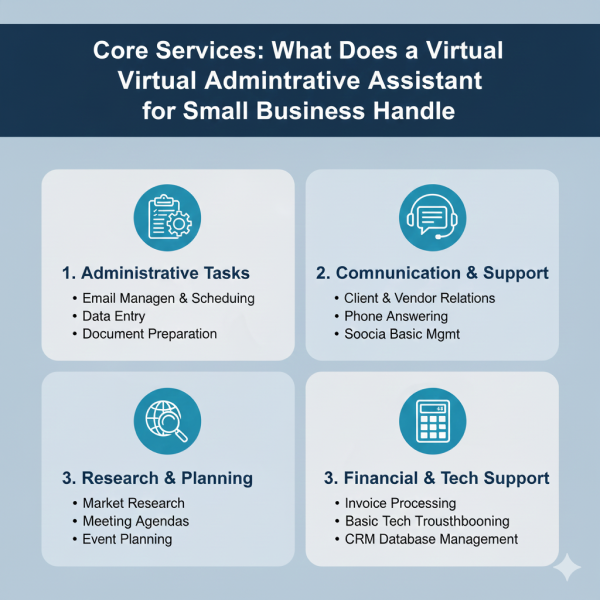
Small business – trained small business remote virtual assistant There are a lot of important tasks that is handled by the skilled virtual admin assistant for small businesses:
Email Wrangling: They keep your inbox tidy, respond to routine messages, stand over the priority items ensuring nothing important goes by. Your inbox becomes something that works for you, instead of against you.
Calendar and Scheduling: Your assistant schedules meetings, sends invites, manages time zones, reschedules conflicts and keeps your calendar running perfectly. No more double bookings, no more scheduling back-and-forth just to book your meeting.
Data Entry and Database Maintenance: Updating customer or client information, records of sales orders, spreadsheet history or other type of file processing is maintained so that your records are always current.
Document Prep: Formatting reports, working on presentations … your assistant tackles all document work so you always look professional and never lose time doing it.
Phone & Email: A lot of virtual assistants take calls, replies to questions and offer base level front end support. Your clients receive that same immediate response while you are locked in deep work.
Travel Planning: If travel is part of your work, you … Continue reading When listing targets feel too confining – The Spreadsheet.. make up a new one!
Invoicing and Expense Tracking: Your assistant can pull together invoices, manage expenses, chase up payments, and ensure that all financial records are filed neatly for your bookkeeper or accountant.
Research Jobs: Looking for competitive analysis, vendor research and market info? Your assistant does all the time-consuming research for you and provides cool, concise summaries.
How to Find the Right Virtual Assistant for Administrative Support for Your Small Business
It’s all about the choice of who you select. Use this equation to determine:
Articulate Your Requirements: Make a complete list of all the administrative activities you plan to delegate. Which are most urgent? Which take the most time? What skills are required? Write a thorough job description before you begin your search.
Set Business Hours: Do you want an agent to be available during your business hours for live support? Or are there things that can be done in parallel? Time zones are important to keep in mind, particularly if you need a live body on the phone.
Establish Your Budget: Determine the budget you can spend before shopping. Rates of virtual assistant can vary between $15 to $50 per hour, depending on your experience, skills and location. Your expectations for what you’ll get at different price points should be realistic.
Seek Experience: The ideal virtual assistant for your small business administrative support needs has a history of working with businesses just like yours. They get your challenges and can add value from day one.
Check References and Reviews: Always talk to former clients. Inquire about reliability, communication, problem solving skills and overall satisfaction.
Test Before Committing: Begin with a project or set period on a test basis. Assign real tasks and watch what they do. Great virtual assistants relax about trial periods because they know they’re gold.
Think Agency Because an individual freelancer is cheaper to hire doesn’t mean you have backup when he or she is sick or unavailable. Agencies which you can outsource your work to? Silkee Solution, for example, will give you standby support with back up spare capacity ( they guarantee quality and professional management) so that things never fall behind!
Benefits of Hiring a Remote Administrative Assistant for Small Business Owners
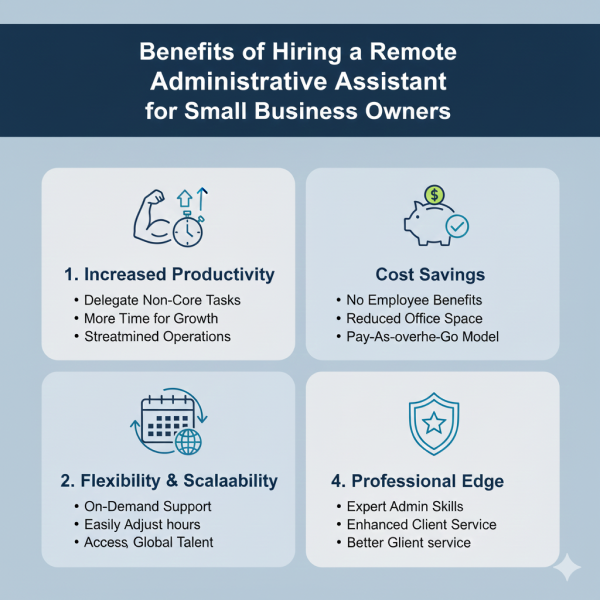
Writing out what’s on your mind comes with a host of benefits that reach far beyond simply crossing things off your to-do list:
Immediate Productivity: With hiring in the brick and mortar world training takes weeks, but with veterans VAs come into your business day one already running for you not to mention being a couple hours work ready. They understand all the typical business tools and processes, so standup takes days rather than months.
There are no physical or geographical limitations – you can tap into talent anywhere in the world. Find skilled people everywhere, which can be particularly useful if you’re in a small town or expensive city with few local people to hire, and where those locals are expensive.
Lower Overhead Costs: No office space required, no computer to purchase, no software licences for you to buy and benefits package that you need to pay. Your only cost is the hourly rate or monthly retainer that you pay them.
Integrated Backup Structured Systems: When you are integrated into professional services, such as Silkee Solution, backup assistants are in place to avoid any disruption if your regular assistant is absent. Your business never takes a day off, not for holidays and certainly not when you are sick.
Novel Perspective and Ideas Virtual assistants have other clients, too. They come to the table with ideas and best practices from other industries that you can apply to your operations.
Continuity: When you have a relationship with dependable admin support, your business doesn’t suffer when family emergencies arise, or you go on holiday or are wrapped up in major projects.
Professional Image:Responding to emails quickly, scheduling yourself with tumbleweeds in the background and communicating in a timely manner makes your small business appear larger and further along then it really is.
Affordable Virtual Assistant Solutions for Small Business Administrative Tasks
Budgets are a fact of life for small businesses. Here’s how you can get good support for cheap:
Begin Part-Time: You don’t need full-time assistance from the beginning. Begin at 10–15 hours per week that you dedicate only to your most time-intensive tasks. Start small and ramp up as you see the value.
Save Cash with Package Deals: The majority of coaches will provide you with a reduced price per session if you sign up for a month at a time. A 20-hour monthly package is usually a lower hourly price than paying as you go.
High-impact Time Management: Spend your assistant’s time on saving you time or money-making tasks. Wait on what work you can.
Think About Offshore Virtual Assistants: You can still get high-quality work for less money. Engage English language ability and communications experience, as narrow job locations will not Help anyone.
5.Group Similar tasks : It’s always easier to do similar stuff in one go. Have your assistant do all data entry on certain days, scheduling everything together in blocks and researching projects at the same time. This way, you maximize your investment and reduce context-switching.
Negotiate Retainer Deals: A lot of virtual assistants will give you a discount if you agree to a certain number of hours per month. “It’s a benefit to both parties — they get steady revenue and you get better pricing.
At Silkee Solution, we know what kind of budget small business have We’re affordable and upfront. Our packages offer a basic level of administration and then grow with you, so you can be assured that you are always getting the best value for your money.
Small Business Virtual Assistant Services: What Tasks Should You Delegate First?
Not sure where to start? Prioritize delegating these first for the most significant impact:
Email Control: If you’re spending more than an hour a day in email, this is your starting point. An assistant can cut your time in email by 70% or more within the first month.”
Calendar Scheduling: Suggesting meeting times, back and forth is a huge waste of time. All the scheduling coordination will be left to your assistant, and hours will come back in to your week.
Data Entry: Forced to think strategically it is an easy distraction. It is additionally inductive to error when you’re on the clock. Data entry is processed in the blink of an eye by our virtual assistants.
Customer Follow-Up: Leads and customers must be answered in a timely manner. Your assistant can take care of the introductory stuff, followup emails and make sure no deals fall through the cracks.
Social Media Posting: If you are online, be out there. Your VA can share blog posts, respond to comments, and maintain visibility in your business while the rest of it runs without you!
Invoice Processing: The faster the invoices are sent out, the better for cash flow. Your assistant gets all the invoices out on time and professionally follows up with late payments.
Meeting Preparation: You could have your recipients prepare the agendas, collate necessary documents and brief you on key meetings. You step in raring to go, rather than spending hours getting prepped.
Tracking Expenses: Placing your receipts and expenses into categories helps simplify tax time. Your helper is now keeping track throughout the year.
Virtual Assistant Companies for Small Business Administrative Help
Choosing between individual freelancers and established companies affects your experience significantly:
Individual Freelancers: These virtual assistants work independently. They typically charge less but you handle all management, quality control, and backup planning. If they’re unavailable, your work stops.
Virtual Assistant Agencies: Companies like Silkee Solution employ or contract with multiple assistants. They provide backup coverage, quality standards, and professional management. You get reliability and consistency at a slightly higher cost.
Specialized Providers: Some companies focus specifically on small business administrative support. They understand the unique challenges small businesses face and tailor services accordingly.
Full-Service Firms: These agencies offer everything from basic administrative support to specialized services like bookkeeping, marketing, and technical support. One provider handles all your outsourcing needs.
Industry-Specific Services: Certain providers specialize in specific industries like real estate, healthcare, or e-commerce. They understand industry-specific workflows and regulations.
Silkee Solution has built its reputation specifically on small business administrative support. We understand that small businesses need reliable, affordable help delivered by professionals who genuinely care about their success. Our virtual assistants are experienced, thoroughly vetted, and backed by our quality guarantee.
How a Virtual Office Assistant Helps Small Businesses Scale Operations
Growth creates new administrative demands. Here’s how virtual office assistants help with scaling:
System Implementation: As you expand, you need better systems. Virtual assistants will facilitate operations, attitude tools for contract management, crm systems and documentation processes to assist scale your business.
Process Documentation: Your assistant will document how things get done which enables them to create standard operating procedures so future team members can be trained quicker.
Quality Control: They can also easily monitor client feedback, measure service delivery and identify issues before they turn into problems. This overlook enables the quality to be kept consistent as you increase production.
Team Coordination: Once you begin hiring other employees or contractors, your remote assistant can keep everybody in the loop, schedule managemement and keep assignments on course.
Scaling Without Full-time Staff: Don’t hire full-timers before you’re ready; scale with virtual assistants up to however many staff hours that matches your needs. Add hours or other assistants as growth continues.”
Market Expansion Assistance: When you open new markets or introduce new products, administrative help with research, outreach and coordination is needed. Virtual assistants offer this capability without adding full time staff.
The companies that do it well are the ones with adaptable support structures. Virtual assistants are that administrative back-bone which enables you to grow without it being admin-chaos.
Outsourcing Administrative Work to Virtual Assistants: Common Concerns Addressed
Many small business owners are slow to delegate. Let’s address the main concerns:
“Can I trust a remote someone with my business? : Trust is built on transparent processes and communication. Begin with low-risk projects and expand your comfort zone as confidence builds. Assistants from professional services like Silkee Solution have already been triple-vetted, and offer protections.
“Will they understand my business?” : Great virtual assistants tend to be quick learners. Give spit-and-polish documentation from the start, and they will quickly come to expect it. Some assistants achieve such deep insight that they become strategic advisers.
“But what if the quality isn’t good?” : Establish quality standards from the outset. Provide feedback regularly. Professional services will provide quality guarantees and change to an assistant if they don’t meet your expectations.
“How do I supervise someone who I never see?” : Working remotely has become business as usual. Leverage project management tools, regular check-ins and straightforward metrics. Remote assistants are generally easier for business owners to manage so long as they don’t overcomplicate the communication process just because it can be more intentional and documented.
“What about data security?” : Trustworthy virtual assistants sign nondisclosure agreements and work on secure platforms. Use standard security technology like password managers and two-factor authentication.
“Is it really cost-effective?” : Find out what your time is really worth. When you bill $100 or your time generates that much, keeping the administrative work in-house with an assistant earning just $25 an hour for a job estimated to take 10 hours every week will save you $750 weekly or about $39,000 annually. The math is compelling.
Best Practices for Working with Your Virtual Assistant for Business Administration
Get more out of your investment with these strategies:
Set Clear Expectations in Writing: Write down exactly what you want done, how you want it done and what success looks like. Explicit instructions avoid misinterpretation and rework.
Set Communication Protocols: Figure out how you all will communicate. Daily check-ins via Slack? Weekly video calls? Email summaries? Open communication solves problems and ends relationships.
Leverage Project Management Tools: Applications such as Asana, Trello, or Monday. com will be able to keep everyone on the same page in terms of priorities, deadlines and progress. Your assistant can keep you updated via the tool versus through regular status emails.
Context, Not Just Tasks: Explain why it even matters. Assistants make better decisions and help even more when they can see the big picture.
Provide Constructive Feedback: Resolve problems directly yet gently. Positive feedback is not only instructive but also shows you are invested in the relationship.
Notice Good Work: You should recognize your assistant when something is done especially well. Recognition engenders loyalty and encourages continued high performance.
Track Stories Together: When your assistant is getting to know your style, ask him or her to document the process. “This creates intel to defend your business and make it easier for training the future assistant.
Trust But Verify: Spot-check work (especially early on) to make sure it’s up to snuff. As trust builds, reduce oversight. Strike the right balance between micromanaging and not being present.
Hiring a Virtual Assistant for Small Business Office Support: Step-by-Step Guide
Ready to hire? Follow this roadmap:
Step 1 – Audit Your Time: Track how you spend time for one week. Identify administrative tasks that don’t require your specific expertise. These are candidates for delegation.
Step 2 – Calculate Your Budget: Determine what you can afford monthly. Remember, good virtual assistants pay for themselves through the time they save and revenue opportunities they enable.
Step 3 – Create a Job Description: List tasks you want delegated, required skills, working hours, and any specific tools or platforms they need to know. Be detailed—it attracts the right candidates.
Step 4 – Decide on Your Hiring Approach: Will you hire an individual freelancer, use a freelance platform, or work with an agency? Each has advantages depending on your needs and management capacity.
Step 5 – Screen Candidates Thoroughly: Review work samples, check references, and have detailed conversations about their experience with businesses like yours.
Step 6 – Start with a Trial Period: Begin with a 30-day trial on clearly defined tasks. This lets both parties assess fit before making long-term commitments.
Step 7 – Onboard Systematically: Share access to necessary tools, provide documentation, introduce them to key contacts, and establish communication norms. Invest time in onboarding—it pays off quickly.
Step 8 – Review and Adjust: Schedule a review after the first month. Discuss what’s working, what needs adjustment, and whether to expand their responsibilities.
Silkee Solution simplifies this entire process. We handle screening, matching you with qualified assistants, and providing structured onboarding. You skip straight to having productive support without the hiring hassle.
Top Virtual Assistant Platforms for Small Business Administrative Needs
Several platforms connect small businesses with virtual assistants:
Dedicated VA Services: Companies like Silkee Solution specialize in providing trained, vetted virtual assistants specifically for small business needs. You get professional management, backup coverage, and quality guarantees.
Freelance Marketplaces: Platforms like Upwork and Fiverr let you browse individual contractors. You handle all vetting, management, and quality control. Prices vary widely based on experience and location.
On-Demand Platforms: Services that assign tasks to available assistants from a pool. Good for one-off projects but less ideal for ongoing administrative support where consistency matters.
Industry-Specific Services: Some platforms focus on specific industries like real estate or healthcare, providing assistants familiar with industry-specific tools and requirements.
Full-Service Outsourcing: BPO (Business Process Outsourcing) companies handle entire business functions. They’re comprehensive but often more expensive and less flexible than dedicated virtual assistant services.
For small businesses, dedicated VA services like Silkee Solution offer the best balance of quality, reliability, and cost. You get professional support without the overhead of freelance marketplace management or the expense of full BPO services.
Virtual Assistant Tasks That Transform Small Business Productivity
Certain administrative tasks deliver outsized returns when delegated:
CRM Maintenance: Keeping your customer database updated, logging interactions, and setting follow-up reminders ensures no customer relationship falls through the cracks.
Report Generation: Regular reports on sales, expenses, project status, or KPIs keep you informed without spending hours in spreadsheets.
Vendor Management: Your assistant can coordinate with suppliers, track orders, resolve issues, and maintain vendor relationships, freeing you from constant vendor communication.
Meeting Coordination: Beyond simple scheduling, assistants can book conference rooms, set up video calls, prepare materials, take notes, and distribute action items afterward.
Content Organization: Whether it’s organizing your Google Drive, maintaining file naming conventions, or archiving old projects, organized digital files save countless hours of searching.
Client Onboarding: New clients need paperwork, access to systems, and introductory information. Your assistant handles the administrative side of onboarding, ensuring smooth starts to every client relationship.
Newsletter and Email Campaigns: Your assistant can draft newsletters, segment email lists, schedule sends, and track results, maintaining your marketing presence consistently.
Appointment Reminders: Automated reminders reduce no-shows for service businesses. Your assistant ensures every client gets timely reminders with necessary preparation information.
Small Business Growth Through Strategic Administrative Delegation
Delegation isn’t just about saving time—it’s strategic business development:
Leadership Development: Learning to delegate effectively makes you a better leader. These skills become essential as your business grows and you manage employees.
Focus on Your Zone of Genius: You started your business because you’re good at something specific. Delegating admin work lets you spend 80% of your time in your area of expertise instead of 50%.
Capacity for New Opportunities: When a big opportunity appears—a potential major client, strategic partnership, or new revenue stream—you have the bandwidth to pursue it because administrative tasks don’t overwhelm you.
Business Sustainability: Businesses that depend entirely on the owner’s personal time and energy can’t sustain growth. Building systems with virtual assistant support creates a business that runs without your constant involvement.
Reduced Burnout Risk: Entrepreneur burnout is real and dangerous. Delegating administrative burden preserves your energy for the long journey of building a successful business.
Market Adaptability: When market conditions change, you need capacity to pivot. Businesses bogged down in administrative chaos can’t adapt quickly. Those with efficient administrative support can respond to market changes decisively.
Companies that use virtual assistants for small business administrative support consistently outperform those where owners try to do everything themselves. The numbers prove it—delegation accelerates growth.
Measuring ROI: Is Your Virtual Assistant Worth the Investment?
Track these metrics to evaluate your return on investment:
Time Savings: Document hours reclaimed weekly. Multiply by your hourly value (what you bill or what revenue-generating activities you can now pursue). Compare to your assistant’s cost.
Revenue Impact: Track new clients acquired, deals closed, or projects completed because you had time freed up. This is often the largest ROI component.
Error Reduction: Fewer missed appointments, forgotten follow-ups, or administrative mistakes saves money and protects your reputation.
Stress Reduction: While harder to quantify, reduced stress improves decision-making, creativity, and health. These factors ultimately impact business success.
Growth Metrics: Compare business metrics before and after hiring support. Did revenue increase? Did you launch that new service? Did customer satisfaction improve?
Opportunity Cost: Calculate opportunities you can now pursue that were previously impossible due to time constraints.
Most small businesses find their virtual assistant pays for themselves within 30-60 days through time savings alone. When you factor in enabled revenue growth, the ROI often exceeds 300-500%.
Silkee Solution provides regular reporting that helps you track these metrics clearly. We want you to see the concrete value we deliver, making the investment decision obvious for continued partnership.
Frequently Asked Questions
How much does a virtual assistant for small business administrative support cost?
Virtual assistant rates typically range from $15 to $50 per hour depending on experience, skills, and location. Most small businesses spend $1,000 to $3,000 monthly for part-time support (20-40 hours). Services like Silkee Solution offer package pricing that delivers better value than hourly rates, with plans designed specifically for small business budgets.
What administrative tasks can I delegate to a virtual assistant?
You can delegate email management, calendar scheduling, data entry, customer service, document preparation, invoice processing, travel booking, research, social media management, CRM updates, and much more. Essentially, any administrative task that doesn’t require your physical presence or specific expertise can be delegated to a skilled virtual assistant.
How do I know if my small business needs a virtual assistant?
If you’re spending more than 10 hours weekly on administrative tasks, working nights and weekends to keep up, missing growth opportunities due to time constraints, or feeling overwhelmed by day-to-day operations, you need administrative support. The cost of a virtual assistant is typically far less than the revenue you’re missing by not focusing on business development.
Is it better to hire a freelance virtual assistant or use a service like Silkee Solution?
Freelancers cost less but offer no backup if unavailable and require you to handle all management and quality control. Services like Silkee Solution provide backup coverage, quality guarantees, professional management, and replace assistants who don’t work out. For business-critical administrative support, the reliability of a professional service typically outweighs the modest cost difference.
How quickly can a virtual assistant start helping my small business?
Experienced virtual assistants typically start contributing within 2-3 days of onboarding. Full productivity takes 2-4 weeks as they learn your systems and preferences. Services like Silkee Solution often enable faster starts because their assistants have standardized training in common business tools and best practices.
Can virtual assistants work with my existing business software?
Yes, experienced virtual assistants work with all common business platforms including Google Workspace, Microsoft Office, QuickBooks, Salesforce, HubSpot, Slack, Asana, Trello, Zoom, and hundreds of other tools. They adapt quickly to your specific software stack and can suggest improvements to your current systems.
What happens if my virtual assistant goes on vacation or gets sick?
Individual freelancers typically don’t provide backup, leaving you without support during their absence. Professional services like Silkee Solution maintain backup assistants trained on your account, ensuring continuity of administrative support regardless of individual availability. This reliability is crucial for business-critical administrative functions.
How do I communicate and manage a remote virtual assistant?
Most businesses use a combination of email, messaging apps like Slack, video calls, and project management tools. Daily or weekly check-ins keep everyone aligned. Clear documentation and defined expectations make remote management straightforward. Many owners find remote assistants easier to manage than in-office staff because all communication is documented.
Is my business information secure with a virtual assistant?
When working with reputable providers, yes. Professional virtual assistants sign confidentiality agreements and use secure systems. Implement standard security practices like password managers, two-factor authentication, and limited access permissions. Services like Silkee Solution thoroughly vet assistants and maintain strict security protocols to protect client information.
Can I start with just a few hours per week and scale up?
Absolutely. Most virtual assistants and services offer flexible arrangements starting from as little as 5-10 hours weekly. This lets you test the relationship and see value before committing to more hours. As your needs grow or you see the benefits, you can easily add more hours or additional assistants to support business expansion.