
Virtual Sales Assistant vs In-House Sales Rep
Choosing between a virtual sales assistant and an in-house sales representative is one of the most critical decisions for growing businesses. Both options offer unique advantages, but understanding their differences in cost, scalability, and performance can help you make the right choice for your sales strategy. This comprehensive comparison will guide you through everything you need to know to build a winning sales team.
Overview: Understanding the Core Differences

A virtual sales assistant is a remote professional who handles sales-related tasks from a different location, often working as an independent contractor or through a specialized service provider. These assistants typically manage lead generation, customer outreach, CRM updates, appointment setting, and follow-up communications.
An in-house sales representative, on the other hand, is a full-time employee who works from your office or physical location. They’re directly embedded in your company culture, attend in-person meetings, and often handle the complete sales cycle from prospecting to closing deals.
The fundamental difference lies in their working arrangement, cost structure, and level of integration with your team. While in-house reps offer immediate physical presence and deeper company immersion, virtual sales assistants provide flexibility, cost savings, and access to specialized skills without geographical limitations.
Cost Comparison: Breaking Down the Numbers

Virtual Sales Assistant Costs
The financial advantage of virtual sales assistants is significant. Typical costs include:
- Hourly rates: $15-$45 per hour depending on experience and location
- Monthly retainers: $1,200-$3,500 for part-time or full-time support
- No overhead expenses: No office space, equipment, or benefits required
- Pay-for-performance options: Some providers offer commission-based structures
When you hire a virtual sales assistant, you eliminate expenses like health insurance, retirement contributions, paid time off, office supplies, and workstation setup. For small to medium-sized businesses, this can translate to savings of 40-60% compared to in-house employees.
In-House Sales Representative Costs
The true cost of an in-house sales rep extends far beyond their base salary:
- Average salary: $45,000-$75,000 annually for entry to mid-level positions
- Benefits package: Additional 20-30% of salary (health insurance, retirement, bonuses)
- Overhead costs: Office space, computer equipment, phone systems, CRM licenses
- Training and onboarding: $5,000-$15,000 in initial investment
- Recruitment costs: Agency fees or internal HR resources
When fully calculated, an in-house sales rep can cost a company $65,000-$100,000 or more annually, making it a substantial investment that requires careful consideration.
Scalability: Adapting to Business Growth

Scaling with Virtual Sales Assistants
Virtual sales assistants offer unparalleled scalability advantages. During peak seasons, you can quickly add multiple assistants to handle increased demand without long recruitment processes or expensive onboarding. When business slows, you can scale down without the complications of layoffs or severance packages.
This flexibility is particularly valuable for:
- Seasonal businesses experiencing fluctuating demand
- Startups testing different markets or sales approaches
- Companies expanding into new territories or time zones
- Businesses launching new products requiring temporary sales support
You can also access specialized skills on-demand, bringing in experts for specific campaigns or market segments without long-term commitments.
Scaling with In-House Teams
Scaling an in-house sales team is a more deliberate, resource-intensive process. Each new hire requires:
- Extended recruitment timelines (4-8 weeks minimum)
- Comprehensive training programs
- Additional office infrastructure
- Long-term financial commitments
However, this slower scaling approach can benefit companies building a cohesive, deeply integrated sales culture. Once established, in-house teams provide consistency and can develop deeper product knowledge and customer relationships over time.
Flexibility: Adapting to Modern Business Needs
Virtual Sales Assistant Flexibility
Virtual sales assistants excel in operational flexibility:
- 24/7 availability: Hire assistants across time zones for round-the-clock coverage
- Project-based work: Engage for specific campaigns without ongoing obligations
- Specialized expertise: Access niche skills like multilingual sales or industry-specific knowledge
- Remote work compatibility: Perfect for distributed teams and digital-first companies
- Quick turnaround: Start new assistants within days rather than weeks
This flexibility allows businesses to experiment with different sales strategies, test new markets, and respond rapidly to opportunities without being constrained by traditional employment structures.
In-House Representative Flexibility
In-house reps offer different types of flexibility:
- Immediate availability: Walk over for quick consultations or strategy sessions
- Multi-role capabilities: Can attend trade shows, conduct demos, or participate in marketing events
- Cultural alignment: Easier to shift responsibilities and collaborate across departments
- Real-time collaboration: Spontaneous brainstorming and problem-solving
The trade-off is less operational flexibility due to fixed schedules, vacation time, and the challenges of reassigning full-time employees to different roles or projects.
Performance Differences: Quality and Results
Virtual Sales Assistant Performance
When properly managed, virtual sales assistants can deliver outstanding performance metrics:
Strengths:
- Specialized focus: Often experts in specific sales tasks like lead generation or appointment setting
- Higher efficiency: Fewer office distractions can lead to increased productivity
- Diverse experience: Exposure to multiple clients brings fresh perspectives and best practices
- Technology proficiency: Typically skilled with modern sales tools, CRM systems, and automation
- Measurable outcomes: Performance easily tracked through digital metrics and KPIs
Considerations:
- Requires strong communication protocols and clear expectations
- May have less emotional investment in company success
- Limited ability to handle complex, relationship-intensive sales requiring face-to-face interaction
- Time zone differences can create coordination challenges
In-House Representative Performance
In-house sales reps bring unique performance advantages:
Strengths:
- Deep product knowledge: Daily immersion leads to comprehensive understanding
- Stronger relationships: Face-to-face interactions build trust with key accounts
- Company culture alignment: Greater commitment to organizational values and long-term goals
- Complex deal management: Better suited for lengthy sales cycles and high-touch relationships
- Cross-functional collaboration: Easier coordination with marketing, product, and customer success teams
Considerations:
- Higher cost per lead and per sale due to overhead
- Potential for office politics and distractions affecting productivity
- Limited perspective if they’ve only worked in one company environment
- Slower adaptation to new tools or methodologies
When to Choose a Virtual Sales Assistant
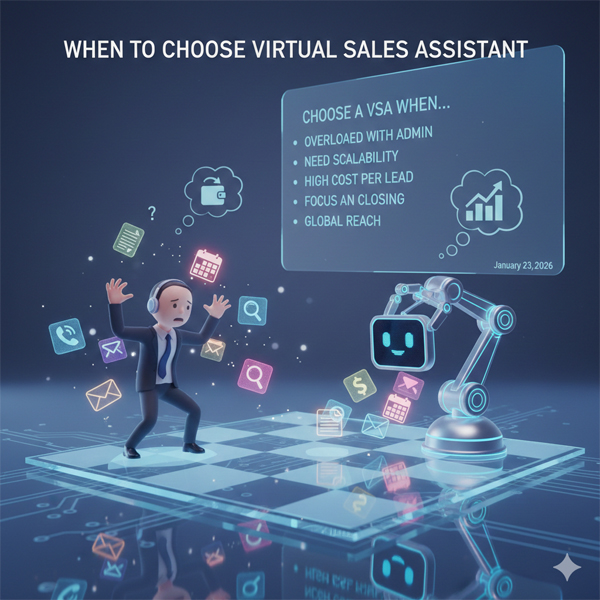
Virtual sales assistants are the optimal choice in several scenarios:
1. Budget-Conscious Growth
If you’re a startup, small business, or company with limited resources, virtual sales assistants provide professional sales support without breaking the bank. You gain immediate capacity to generate leads and nurture prospects while preserving capital for other critical investments.
2. Scaling Rapidly
When you need to quickly expand sales capacity—whether entering new markets, launching products, or capitalizing on seasonal opportunities—virtual assistants can be onboarded in days rather than months.
3. Specialized Tasks
For businesses needing specific sales functions like lead qualification, data entry, appointment setting, or email campaigns, virtual assistants with specialized expertise deliver better results than generalist in-house reps.
4. Testing New Markets
Before committing to full-time staff in a new territory or demographic, virtual sales assistants allow you to test market viability with minimal risk and investment.
5. Remote-First Organizations
Companies already operating with distributed teams find virtual sales assistants integrate seamlessly into their existing workflows and culture.
6. Supplementing Existing Teams
Even with in-house reps, virtual assistants can handle time-consuming administrative tasks, freeing your core team to focus on closing high-value deals.
When to Choose an In-House Sales Representative
In-house sales reps are preferable in these situations:
1. Complex B2B Sales
When your sales process involves long cycles, multiple stakeholders, technical demonstrations, and relationship-building over months or years, in-house reps provide the consistency and depth required.
2. High-Value Transactions
For enterprise sales or high-ticket items where trust and personal relationships are paramount, having dedicated in-house representatives builds the credibility needed to close major deals.
3. Extensive Product Training Required
If your product or service requires weeks of training, deep technical knowledge, or hands-on experience, the investment in an in-house rep becomes more justified.
4. Local Market Presence Essential
Some industries and regions still value face-to-face interaction, local networking events, and physical presence. In-house reps excel in these environments.
5. Building Company Culture
When creating a strong sales culture, developing talent, and fostering long-term career growth are priorities, in-house teams provide the foundation for sustainable organizational development.
6. Immediate Collaboration Needs
Businesses requiring constant cross-functional collaboration, impromptu strategy sessions, and real-time problem-solving benefit from the immediacy of in-house staff.
The Hybrid Approach: Best of Both Worlds
Forward-thinking companies increasingly adopt hybrid sales models that combine virtual sales assistants and in-house representatives for maximum effectiveness.
How Hybrid Teams Work
In a hybrid model, you leverage each resource type for its strengths:
- Virtual sales assistants handle top-of-funnel activities: lead research, initial outreach, qualification, appointment setting, CRM management, and follow-up sequences
- In-house sales reps focus on high-value activities: conducting demos, negotiating contracts, closing deals, managing key accounts, and strategic planning
This division of labor maximizes ROI by ensuring expensive in-house talent focuses exclusively on revenue-generating activities while virtual assistants handle essential but lower-level tasks.
Benefits of the Hybrid Model
Cost Optimization: Reduce overall sales costs while maintaining effectiveness by right-sizing your team composition.
Improved Productivity: In-house reps freed from administrative burden can increase their deal volume by 30-50%.
Scalability with Stability: Scale your lead generation and outreach capacity (virtual) while maintaining consistent relationship management (in-house).
Risk Mitigation: Don’t rely entirely on remote workers or exclusively on costly employees—balance provides resilience.
24/7 Coverage: Virtual assistants in different time zones ensure continuous prospect engagement while in-house reps work standard hours.
Implementing a Hybrid Sales Team
To successfully implement a hybrid approach:
- Define clear roles: Document exactly which tasks each team member handles to prevent confusion or duplication
- Establish communication protocols: Use project management tools, daily standups, and shared CRM systems to keep everyone aligned
- Create seamless handoffs: Develop standardized processes for transitioning leads from virtual assistants to in-house closers
- Measure performance separately: Track KPIs appropriate to each role (virtual: leads generated, appointments set; in-house: deals closed, revenue)
- Foster team unity: Include virtual assistants in team meetings, celebrations, and training to build cohesion despite physical distance
Making Your Decision: Key Considerations
When deciding between virtual sales assistants, in-house reps, or a hybrid model, evaluate these critical factors:
Your Budget Reality
Calculate not just what you can afford now, but what your cash flow projections support over the next 12-24 months. Virtual assistants provide flexibility if budget certainty is low.
Sales Complexity
Map your typical sales cycle. The more touchpoints, decision-makers, and customization required, the more you’ll benefit from in-house expertise.
Growth Trajectory
Rapid growth favors virtual assistants for quick scaling. Steady, predictable growth supports in-house team building.
Geographic Considerations
Selling across multiple time zones or regions? Virtual assistants provide coverage. Focused on local markets? In-house reps build stronger community connections.
Technology Infrastructure
Companies with robust CRM systems, communication platforms, and sales enablement tools can more easily manage virtual teams. Less sophisticated setups may require the simplicity of in-house coordination.
Management Capacity
Virtual teams require different management skills—remote oversight, asynchronous communication, and results-based evaluation. Assess whether your leadership team has this capability.
Ready to Enhance Your Sales Team?
Whether you choose virtual sales assistants, build an in-house team, or implement a hybrid approach, the key to success lies in strategic planning and choosing the right partners.
Virtual sales assistants offer:
- Immediate cost savings of 40-60%
- Rapid scalability to match business demands
- Access to specialized sales expertise
- Operational flexibility for modern businesses
Looking for professional virtual sales assistant services? Silkee Solutions (silkeesolutions.com) specializes in providing highly-trained virtual sales assistants who integrate seamlessly with your existing team. Their experienced professionals can handle everything from lead generation to appointment setting, allowing your business to scale efficiently without the overhead of traditional hiring.
Don’t let budget constraints or scaling challenges hold back your sales growth. Explore how virtual sales assistants can transform your sales operations while maintaining the quality and performance your business demands.
Take the next step in optimizing your sales strategy—whether that means going fully virtual, maintaining in-house excellence, or creating a powerful hybrid model that leverages the best of both approaches.
Frequently Asked Questions
What is a virtual sales assistant?
A virtual sales assistant is a remote professional who handles sales-related tasks such as lead generation, prospect research, appointment setting, CRM management, email outreach, and customer follow-ups. They work remotely using digital tools and communication platforms to support your sales objectives without being physically present in your office.
How much does a virtual sales assistant cost compared to an in-house sales rep?
Virtual sales assistants typically cost $15-$45 per hour or $1,200-$3,500 monthly for full-time support, representing 40-60% savings compared to in-house reps. In-house sales representatives cost $65,000-$100,000+ annually when factoring in salary, benefits, overhead, equipment, and training expenses.
Can virtual sales assistants deliver the same results as in-house sales reps?
Yes, virtual sales assistants can deliver excellent results, particularly for specific tasks like lead generation, qualification, and appointment setting. However, for complex B2B sales requiring extensive relationship-building and face-to-face interactions, in-house reps may perform better. The key is matching the right resource to the right sales activities.
What tasks can I delegate to a virtual sales assistant?
Virtual sales assistants excel at lead research and prospecting, initial outreach via email and phone, lead qualification and scoring, appointment scheduling, CRM data entry and management, follow-up communication sequences, social media outreach, sales reporting and analytics, and customer database management. They handle time-consuming administrative tasks that free your core team for closing deals.
How quickly can I hire and onboard a virtual sales assistant?
Through professional service providers like Silkee Solutions, you can typically have a virtual sales assistant started within 3-7 days. This includes matching you with qualified candidates, brief orientation, and system access setup—significantly faster than the 4-8 weeks required to recruit, hire, and onboard an in-house employee.
What is a hybrid sales team and how does it work?
A hybrid sales team combines virtual sales assistants and in-house sales representatives, with each handling tasks suited to their strengths. Virtual assistants manage top-of-funnel activities like lead generation and appointment setting, while in-house reps focus on relationship-building, demos, negotiations, and closing deals. This approach optimizes costs while maintaining sales effectiveness.
Do I need special technology to work with virtual sales assistants?
Basic sales technology suffices for most virtual assistant arrangements. You’ll need a CRM system (like HubSpot, Salesforce, or Pipedrive), communication tools (Slack, Zoom, or Microsoft Teams), and project management software (Asana, Trello, or Monday.com). Most virtual sales assistants are already proficient with popular sales platforms and can adapt quickly to your existing tech stack.
Which industries benefit most from virtual sales assistants?
Virtual sales assistants deliver value across most industries, but they’re particularly effective for SaaS companies, real estate agencies, insurance providers, B2B service businesses, e-commerce companies, consulting firms, healthcare services, financial services, and technology startups. Any business with scalable sales processes and digital communication channels can benefit.
How do I manage and measure virtual sales assistant performance?
Manage virtual sales assistants through clear KPIs such as leads generated, appointments scheduled, conversion rates, call/email volume, response times, and pipeline value created. Use your CRM system to track activities, schedule regular video check-ins (daily or weekly), implement project management tools for transparency, and establish clear communication protocols with defined expectations and deliverables.
Where can I find reliable virtual sales assistant services?
Silkee Solutions (silkeesolutions.com) is a leading provider of professional virtual sales assistant services, offering pre-vetted, trained sales professionals who can integrate with your team immediately. They provide flexible engagement models, specialized industry expertise, and ongoing support to ensure your virtual sales assistants deliver measurable results for your business.