
Most insurance leads aren’t exclusive. A prospect requesting a quote online is frequently shopping the same request to three, five, sometimes eight carriers or agencies at once — and industry data consistently shows the first agent to actually respond closes the business roughly 78% of the time. A sales virtual assistant for insurance agents exists to make sure you’re the one who responds first, every time, without pulling you off the phone calls that actually close deals.
This is a different role than back-office policy servicing. A sales virtual assistant for insurance agents is focused entirely on the front end of the funnel — lead response, follow-up, pipeline hygiene, and appointment setting — so your CRM reflects reality and no lead goes cold waiting on you.

Why insurance sales specifically needs a dedicated VA
Insurance lead generation has a structural problem most other industries don’t deal with in the same way: leads are commonly sold to multiple agents or agencies simultaneously through lead aggregators and comparison sites. The prospect isn’t choosing based on who has the best coverage — in the first few minutes, they’re choosing based on who calls back first.
That creates a real tension for a working agent. The moments you’re most valuable — on the phone closing a warm prospect — are exactly the moments a new lead is most likely to arrive and start decaying. A sales virtual assistant for insurance agents resolves that by owning first-touch response while you stay focused on the conversation already in progress. If admin work generally is the bigger drain right now, our guide on stopping the admin overload as an independent agent covers the broader picture.
What a sales virtual assistant for insurance agents handles
First-touch lead response
Your VA monitors incoming leads from your website, lead aggregators, and referral sources, and initiates first contact immediately — a call attempt, a text, or an email depending on your process — so the prospect hears from your agency first, not a competitor.
Lead qualification
Not every lead is ready for a licensed conversation. Your VA gathers basic information — coverage type, current provider, timeline — and books qualified prospects directly onto your calendar, so you’re spending your time on people ready to talk, not chasing down basic details yourself.
CRM and pipeline management
Your VA keeps deal stages, follow-up dates, and contact records current in your CRM — AgencyZoom, HubSpot, or whatever you run — so your pipeline reflects what’s actually happening rather than what you remember from a call last week.
Follow-up sequences
Most lost deals aren’t lost on the first call — they’re lost on the third or fourth follow-up that never happened. Your VA runs a consistent follow-up cadence on every open lead so prospects don’t go cold simply because nobody circled back. For the full mechanical breakdown of how this actually works day to day, see our guide to how virtual assistant lead generation works in practice.
Appointment scheduling
Your VA handles the back-and-forth of booking calls and demos directly onto your calendar, confirming appointments ahead of time so fewer prospects no-show.
Renewal and cross-sell flagging
Your VA flags existing clients approaching renewal or showing signs of being a fit for additional coverage, surfacing warm opportunities inside your existing book rather than only chasing new leads.
What a sales VA should never handle
Speed matters, but licensing boundaries don’t move because a lead is time-sensitive. A sales virtual assistant for insurance agents should never quote coverage, discuss policy terms, or give advice that requires a license — their job is getting a qualified, interested prospect onto your calendar quickly, not closing the sale themselves. That distinction stays firm even during a fast-moving lead response.
Sales VA vs. Insurance Concierge — which do you need?
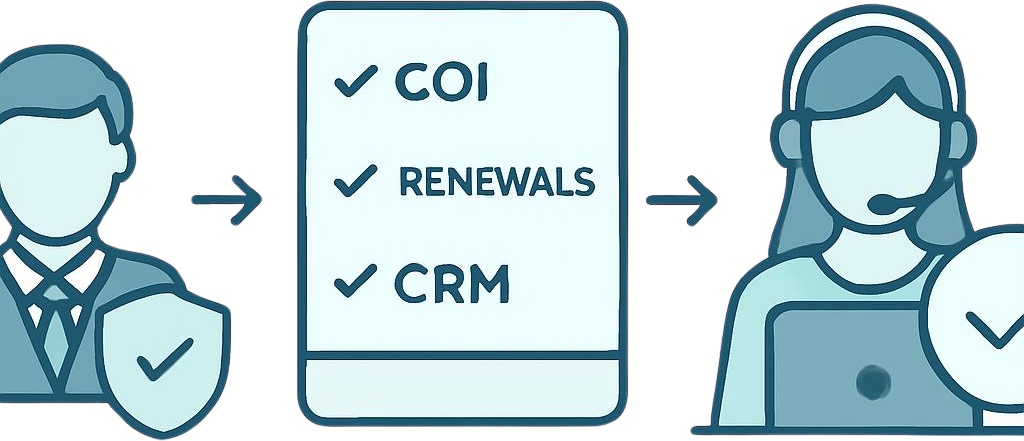
These are two different problems with two different fixes. If leads are going cold, your pipeline is messy, or you’re losing business to whoever calls back first, that’s a sales VA problem — our Sales Assistant package is built for exactly this. If the issue is policy servicing, renewals, COIs, or back-office volume, that’s an Insurance Concierge problem instead. Many agencies eventually run both, but they solve genuinely different bottlenecks — start with whichever one is actually costing you business right now.
Ready to get started?
We offer a free VA trial with $0 setup fee for new clients. Most agencies are live within 5–7 business days of their first call.
Book a free consultation, or see how our insurance virtual assistant cost compares to hiring in-house before you reach out.
Frequently asked questions
How fast does a sales VA actually respond to a new lead?
Response targets are set during onboarding based on how your leads arrive and your agency’s hours of coverage. The goal is always first contact ahead of competing agents, since insurance leads are commonly shopped to multiple providers at once and the fastest responder has a well-documented advantage.
Can a sales VA quote insurance to a prospect?
No. A sales VA qualifies and books the appointment; only a licensed agent can quote coverage, discuss policy terms, or bind a policy. This boundary is set clearly during onboarding.
Does a sales VA work with our existing CRM?
Yes — our VAs work inside the CRM and lead management tools you already use, including AgencyZoom and general platforms like HubSpot, rather than requiring you to change systems.
Sales Assistant or Insurance Concierge — can I get both?
Yes, many agencies eventually run both packages side by side once they’ve identified their biggest bottleneck first. We’d recommend starting with whichever problem — lost leads or back-office volume — is costing you the most right now, and adding the second once the first is under control.
How fast can an agency get started?
Most agencies are live within 5–7 business days of their first call, with no setup fee.
Pingback: Why Your Sales Follow-Up Is Falling Through the Cracks (And How to Fix It) | Silkee Solutions
Pingback: Virtual Assistant for Insurance Lead Generation | Silkee
Pingback: How Much Time Insurance Agents Spend on Sales Admin