
Insurance agents have always been time-poor. Between policy renewals, client follow-ups, carrier communications, compliance documentation, and prospecting, a licensed producer can easily burn 40% of their week on tasks that don’t require a license at all. That number isn’t going down — it’s getting worse as client expectations rise and agency margins tighten.
The answer isn’t hiring a full-time staff member. It isn’t outsourcing everything to a generic VA either. The agencies pulling ahead in 2026 are doing something different: they’re running a hybrid model — a skilled human virtual assistant working alongside AI tools to deliver the kind of back-office support that used to require a full operations team.
This is the AI-augmented virtual assistant model. And if you’re an insurance agent still handling your own inbox, quoting admin, and renewal reminders, this playbook is for you.

Why 2026 Is the Inflection Point for Insurance VA Support
The virtual assistant industry crossed a major threshold this year. The global VA services market is now valued at over $23.8 billion — up from $19.6 billion just a year ago — and is projected to hit $34.4 billion by 2030. More importantly for insurance agents, over 40% of VAs now actively use AI-powered tools to automate scheduling, inbox triage, data entry, and customer support tasks. That figure is expected to climb sharply before the year ends.
What this means practically: a single well-equipped virtual assistant in 2026 can do the work that previously required two or three support staff. The cost stays similar. The output more than doubles. For an independent insurance agency running lean, that’s not a marginal improvement — it’s a structural advantage.
There’s also a competitive timing element. With shifting client acquisition patterns — over 53% of first-time insurance buyers now start their journey digitally — agencies that can respond faster, follow up more consistently, and stay present across more touchpoints are winning business that used to go to the biggest office on Main Street. AI-augmented VA support is how smaller agencies close that gap.
What “AI-Augmented” Actually Means in an Insurance Context
The term gets used loosely, so let’s be precise about what it means for a real insurance agency workflow.
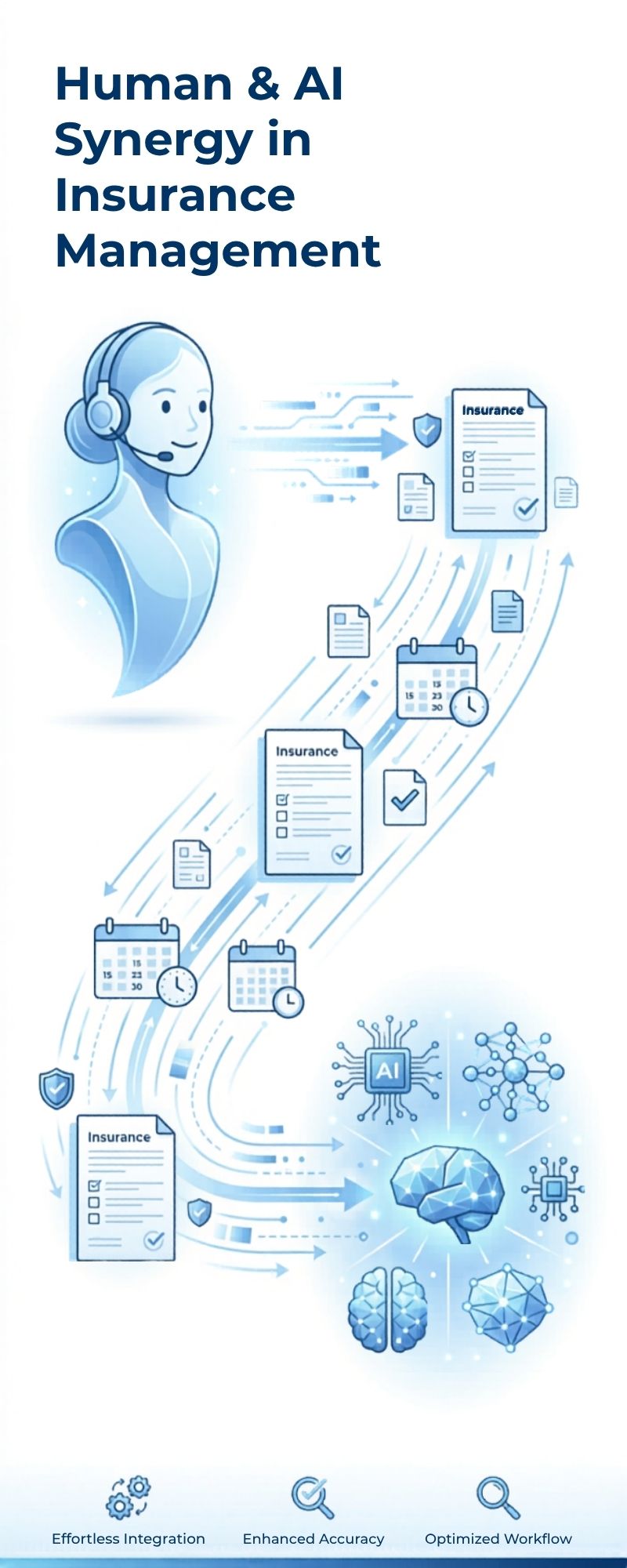
An AI-augmented virtual assistant is a human VA — skilled, trained, experienced — who uses artificial intelligence tools as productivity multipliers. They’re not a chatbot. They’re not a fully automated system. They’re a real person who drafts faster with AI writing tools, processes data faster with AI-powered spreadsheets, handles routine communications with AI-assisted templates, and flags compliance issues with AI-enhanced review tools.
The human element stays in place for everything that matters: judgment calls, sensitive client conversations, escalations, and relationship-building. The AI handles the mechanical throughput — reducing turnaround time on every task without reducing quality or accountability.
The 7 Insurance Tasks Where AI-Augmented VAs Deliver the Highest ROI
Not every task benefits equally from the hybrid model. Here are the areas where AI-augmented support produces the most measurable impact for insurance agencies.
1. Policy Renewal Outreach
Renewal season is simultaneously the highest-revenue period and the highest-stress period for most agencies. An AI-augmented VA can pull the renewal pipeline from your AMS, draft personalized outreach emails for each client using AI writing tools, schedule the outreach sequence, and log all activity back into your CRM — without the producer touching a single email template. Agencies using structured VA-managed renewal workflows report retaining 10–15% more clients annually simply because no one falls through the cracks.
2. Quote Request Processing and Follow-Up
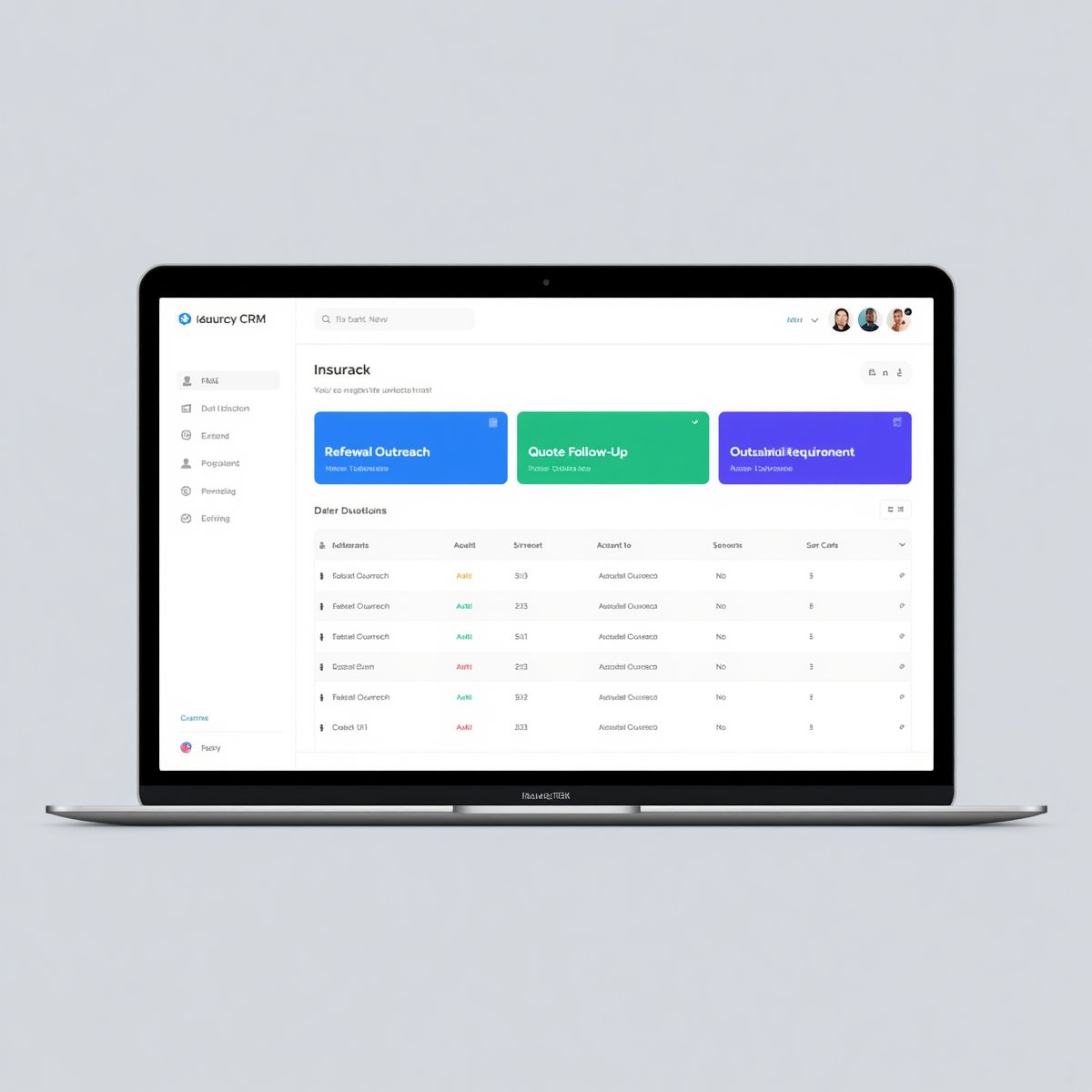
Inbound quote requests are high-intent leads. They’re also time-sensitive — the prospect who doesn’t hear back within 30 minutes is already talking to a competitor. An AI-augmented VA monitors the intake queue, organizes quote requests by urgency and coverage type, pulls relevant data, pre-populates carrier forms where possible, and flags the producer to take over only at the decision point. Response time drops from hours to minutes. Close rates go up. For the full mechanical breakdown of how lead response and follow-up actually works day to day, see our guide to virtual assistant lead generation in practice.
3. Carrier Communication and Requirements Tracking
Outstanding requirements from carriers are one of the biggest silent revenue drains in insurance agencies. Every pending item sitting unresolved is revenue that hasn’t been booked. A VA dedicated to requirements tracking — using AI tools to categorize, prioritize, and draft follow-up communications — can cut your outstanding requirements backlog by 50% or more within the first 30 days.
4. Certificate of Insurance (COI) Processing
COI requests are necessary, repetitive, and a near-constant drain on producer time in commercial lines agencies. An AI-augmented VA handles the full request-to-delivery cycle: receiving the request, verifying coverage, generating the certificate using approved templates, routing it to the appropriate contact, and logging the transaction. What used to take 20–30 minutes per COI takes under five.
5. Client Onboarding Documentation
New client onboarding involves a predictable set of documents, data collection steps, and system entries every time. An AI-augmented VA builds and manages this workflow end-to-end — intake forms, welcome packets, policy summaries, CRM setup, and the first 30-day check-in sequence. Producers who delegate onboarding entirely report saving an average of four to six hours per new client. Over a year, that adds up to weeks of selling time recovered.
6. Social Media and Content Scheduling
Insurance agencies that maintain a consistent social presence generate more referrals and retain clients longer — but most producers don’t have time to post consistently. An AI-augmented VA uses AI content tools to draft compliant, on-brand social content, schedule it across platforms, and monitor engagement. The producer reviews and approves. The calendar stays full without the producer spending a minute on it.
7. Appointment Scheduling and Calendar Management
This one sounds basic, but the compounding time cost is significant. Back-and-forth scheduling emails, calendar conflicts, missed reminders, and rescheduling requests can consume 45–60 minutes per day for a busy producer. An AI-augmented VA owns the calendar entirely — scheduling, confirming, rescheduling, and sending pre-meeting prep packets — so the producer shows up prepared with zero scheduling overhead.
The Human + AI Model vs. Pure AI Automation: What Insurance Agents Need to Know
It’s worth addressing the obvious question: if AI tools can do all of this, why do you need a human VA at all?
The answer comes down to judgment, relationships, and compliance. Insurance is a regulated, relationship-driven industry. Clients in difficult claims situations need empathy, not automation. Compliance documentation requires human review and accountability. Complex coverage conversations require experience and nuance that no AI tool can replicate reliably in 2026 — or likely for some time after.
Pure AI solutions are getting better at handling high-volume routine inquiries. But the agencies seeing the best outcomes aren’t choosing between human and AI — they’re combining both. The human VA brings contextual judgment, relationship continuity, and professional accountability. The AI tools bring speed, scale, and consistency on repetitive tasks. Together, they deliver an outcome neither can match alone.
What to Look for in an Insurance-Focused VA in 2026
Not every virtual assistant is equipped to work in an insurance agency environment. The stakes are higher than in general business admin — client data is sensitive, compliance requirements are real, and mistakes in policy documentation can have serious consequences.
When evaluating a VA provider for your insurance agency, look for these five things:
Insurance industry familiarity. Your VA should understand the difference between P&C and life/health, know what an AMS is, recognize common carrier names, and be familiar with basic compliance language. This isn’t something that can be trained in a week.
Experience with insurance tools. The most commonly used platforms in US insurance agencies include Applied Epic, EZLynx, AgencyZoom, HawkSoft, QQCatalyst, and NowCerts. A VA who has worked in these systems before requires far less onboarding time and makes far fewer errors.
Data handling protocols. Insurance agencies handle personally identifiable information (PII) constantly. Your VA provider should have documented data security protocols, and your VA should be trained on them. Ask directly how client data is handled and stored.
Communication quality and availability. US insurance agency operations typically run on Eastern or Central time. Your VA should be available during your core operating hours and communicate clearly in written English at a professional standard.
A replacement guarantee. VA relationships don’t always work out. A quality provider will offer a replacement guarantee — typically at no cost — so you’re not left scrambling if the fit isn’t right.
How to Structure the First 30 Days With an Insurance VA
The biggest mistake agency owners make when bringing on a VA is dumping tasks on them from day one without a clear structure. The result is confusion, errors, and frustration on both sides. A more effective approach:
Week 1: Documentation and system access. Spend the first week documenting your current workflows — even rough SOPs are better than nothing. Give your VA read access to key systems before write access. Let them observe, ask questions, and map the landscape before executing.
Week 2: Low-stakes delegation. Start with the tasks that carry the least risk if something goes wrong — scheduling, inbox sorting, data entry. This builds confidence and reveals any gaps in the initial documentation.
Week 3: Higher-stakes workflows. Once the low-risk tasks are running smoothly, introduce renewals outreach, COI processing, and carrier follow-up. Review the first few outputs together before the VA handles them independently.
Week 4: Full handoff and feedback loop. By the end of the first month, the VA should be running the delegated workflows with minimal oversight. Schedule a weekly 15-minute check-in to maintain alignment and catch anything drifting off-track.
The ROI Case: What Insurance Agents Actually Save
Let’s put real numbers on this. A busy independent insurance producer working without VA support typically loses 15–20 hours per week to administrative work — renewals, COIs, scheduling, carrier follow-up, data entry, inbox management. At an average producer billing rate of $75–$150 per hour in recovered selling time, that’s $1,125–$3,000 per week in opportunity cost.
A fully managed insurance VA through a specialist provider runs $1,500–$2,500 per month for full-time support, depending on the scope of work and included AI tooling. For a full breakdown of pricing models and a calculator to run your own numbers, see our guide to insurance virtual assistant cost. Even at the top end of that range, the ROI is strongly positive within the first 30 days — and compounds as the VA builds deeper familiarity with the agency’s systems and clients.
Agencies that have made the switch consistently report not just time savings but revenue gains: faster quote response times, higher renewal retention, and more prospecting hours recovered. The math isn’t close.
Is Now the Right Time to Hire an Insurance VA?
If you’re spending more than 10 hours a week on tasks you could hand to someone else, the answer is yes. The question is whether you hire a generalist VA who will need months of insurance-specific training, or a specialist VA service built specifically for insurance agency operations.
At Silkee Solutions, our Insurance Concierge service is designed for exactly this scenario — a trained, managed virtual assistant familiar with insurance workflows, available during your agency’s operating hours, with zero setup cost and a replacement guarantee. Whether you need support with renewals, COIs, carrier follow-up, client onboarding, or all of the above, we handle the back office so you can stay focused on the revenue-generating work only you can do.
If you run a captive agency, the fundamentals above still apply, but carrier-specific rules matter — see our dedicated breakdowns for Farmers Insurance agents, Allstate agents, State Farm agents, and American Family agents for guidance on what’s in and out of bounds under each agreement. Florida agent dealing with hurricane season and Citizens Insurance complexity? See our Florida-specific guide. And if you’re still deciding what to delegate first, our breakdown of insurance admin tasks worth outsourcing is a good starting point. Comparing providers directly? See our honest breakdowns of InsBOSS, VirtualNexgen, Cover Desk, XAssure, Agency VA, and PeopleBlue as alternatives. If lead follow-up is your actual bottleneck rather than back-office work, see our guide to a sales virtual assistant for insurance agents. In a hurricane-exposed state? See our guide to handling catastrophe season surges before the next season hits, or our Louisiana-specific guide covering the state’s ongoing property insurance market recovery, our South Carolina guide covering the state’s distinct SCWHUA coastal insurance structure, or our Virginia guide covering how to manage a book spanning genuinely different regional markets. Writing life insurance specifically? See our guide to virtual assistants for life insurance agents, including the replacement-regulation boundaries that don’t apply to P&C. Writing annuities? See our guide to annuity administration outsourcing, covering NAIC Model #275 suitability documentation. Selling Medicare? See our guide to Medicare insurance virtual assistant support, covering CMS Scope of Appointment and AEP readiness. Comparing providers more broadly first? Our complete guide to choosing a virtual assistant service covers pricing, flexibility, and response time across the market. Writing flood coverage? See our guide to flood insurance virtual assistant support, covering NFIP’s WYO and Agency Registry structure. Running commercial lines specifically? See our commercial insurance VA guide, covering submission prep, COI management, and renewal coordination for complex accounts.
Ready to see what a specialist insurance VA can do for your agency? Schedule a free 15-minute call →
Need sales support rather than back-office help? See our guide to choosing the best virtual sales assistant for your business.
Frequently Asked Questions
What does an AI-augmented virtual assistant do differently from a regular VA?
An AI-augmented VA uses AI tools — writing assistants, scheduling automation, data processing software — to complete tasks faster and at higher volume than a standard VA working manually. The human VA still drives the work; the AI tools multiply their output, typically by 2–3x on routine tasks.
Do I need to provide the AI tools, or does the VA come equipped?
This depends on the provider. At Silkee Solutions, our VAs come equipped with the tools they need. You provide access to your AMS, CRM, and email — we handle the rest.
Is an insurance-specific VA worth the premium over a generalist?
For most insurance agencies, yes — significantly. A VA with insurance industry familiarity requires far less onboarding, makes fewer compliance-adjacent errors, and can take on higher-value tasks (like carrier communications and renewal workflows) much sooner than a generalist who’s learning the industry from scratch.
How quickly can a VA be up and running in my agency?
With a structured onboarding process, most insurance VAs are handling core workflows independently within two to three weeks. Full operational handoff typically happens by the end of the first month.
What if the VA isn’t a good fit for my agency?
Silkee Solutions offers a replacement guarantee at no additional cost. If the fit isn’t right, we replace your VA — no lengthy contract negotiations, no service gap.