
Table of Contents
ToggleWhat a $800/Month Insurance VA Actually Delivers (Task Breakdown)

When agency owners ask about insurance virtual assistant cost, they usually get a price range — but rarely a clear picture of what that price actually buys them week to week. A $800/month retainer sounds like either a bargain or a mystery depending on your frame of reference, and most providers don’t help by describing their services in vague terms like “comprehensive support.”
This post breaks it down task by task — what a well-scoped $800/month insurance VA actually does in a typical week, how many hours each task takes, and how that output compares to what you’d pay for part-time in-office support doing the same work.
What 20 Hours of Insurance VA Support Looks Like Each Week
A $800/month retainer for an insurance-specialist VA typically covers roughly 20 hours of operational work per week — the equivalent of a half-time employee without payroll taxes, benefits, or the onboarding lag of a generalist hire. Within those 20 hours, a well-scoped engagement covers five to seven recurring operational task categories that directly affect policy retention and producer capacity.
The tasks below represent a realistic scope for a small to mid-size independent agency. Not every agency needs all of them — but most agencies are currently doing most of them using producer time, which is a significantly more expensive way to get the same work done.
Hours are estimates based on typical agency volume. Agencies with larger books or higher renewal concentrations will have heavier weeks in specific categories — renewal outreach and outstanding requirements in particular tend to spike around quarter-end and policy anniversary months.
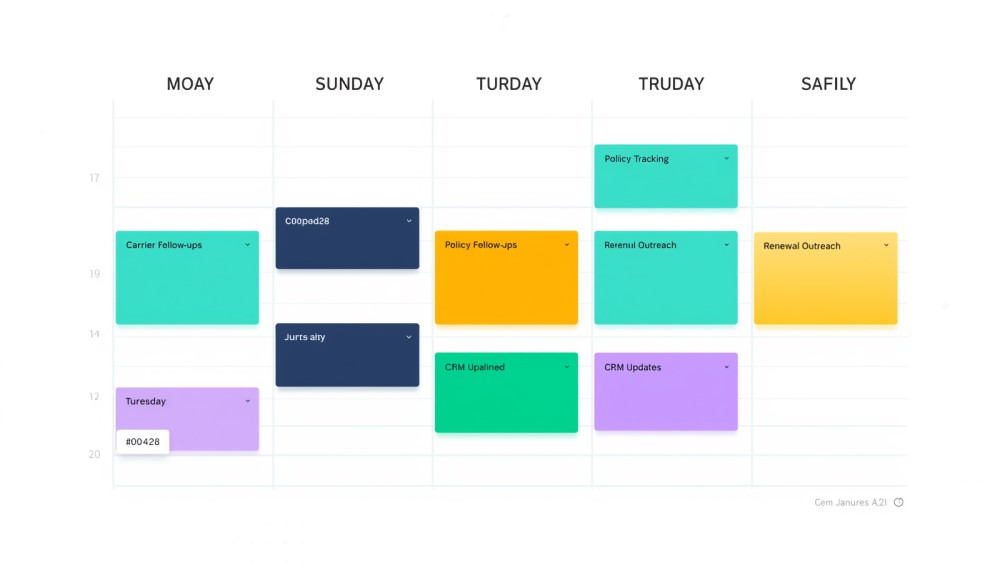
Outstanding requirement tracking
Daily check + carrier follow-up
Renewal outreach sequence
Weekly touchpoints per renewal cycle
Carrier coordination calls
As needed, daily queue clearance
CRM data entry & hygiene
Daily updates after each task
Payment reminder follow-up
Bi-weekly lapse prevention outreach
COI requests & processing
As received, same-day turnaround
Client communication templates
Ongoing — approvals tracked
Total weekly output
📊 Hours vary by agency size and book concentration. Renewal-heavy months (Q4, anniversary clusters) typically see outreach and outstanding requirement hours spike by 20–30% — a well-scoped retainer with a specialist VA flexes with this naturally.
Renewal Outreach (4 hrs/wk)
Consistent renewal touchpoints — sent on schedule, tracked in CRM, escalated to producer only when client responds with a coverage question.
Outstanding Requirements (5 hrs/wk)
Daily status check, carrier follow-up by phone or portal, status note updated in AMS before end of business. Nothing sits open more than 48 hours.
Payment & Lapse Prevention (2 hrs/wk)
Bi-weekly payment reminder outreach on at-risk policies, escalation flagged to producer before the grace period closes.
$800/Month VA vs Part-Time In-Office Staff: The Full Cost Picture
The most direct way to evaluate insurance virtual assistant cost is to compare it against the realistic alternative: part-time in-office administrative support handling the same scope of work.
A part-time administrative hire working 20 hours per week at $18 to $22 per hour costs roughly $1,440 to $1,760 per month in base wages alone — before employer payroll taxes, benefits contribution, onboarding time, and the insurance-specific training investment that a general admin hire requires before they can work independently on policy operations.
An insurance-specialist VA at $800 per month arrives already trained on insurance workflows and AMS platforms. The onboarding focuses on your agency’s specific processes rather than basic industry orientation — which means the break-even point on productivity arrives in the first week, not the fourth.
“An insurance-specialist VA at $800/month arrives already trained on insurance workflows and AMS platforms. The onboarding focuses on your agency’s specific processes — which means productivity arrives in week one, not week four.”
— Cost comparison insight
The Real Return on Insurance Virtual Assistant Cost: Retention Math
The financial case for a VA is clearest when you look at retention impact rather than just hours worked. The tasks in a typical $800/month VA scope — renewal outreach, payment reminders, outstanding requirement follow-up — are directly linked to whether policies lapse or stay on the books.
Consider an agency with 350 active policies and an average premium of $1,100. If consistent follow-up prevents even five policy lapses per month that would otherwise have lapsed due to missed communication, that’s $5,500 in preserved annual premium from those five clients alone — nearly seven times the monthly VA cost.
That’s not a theoretical outcome. It’s what structured, consistent operational support does when it runs reliably — and it’s the metric that most agency owners undervalue when thinking about VA cost versus VA return.
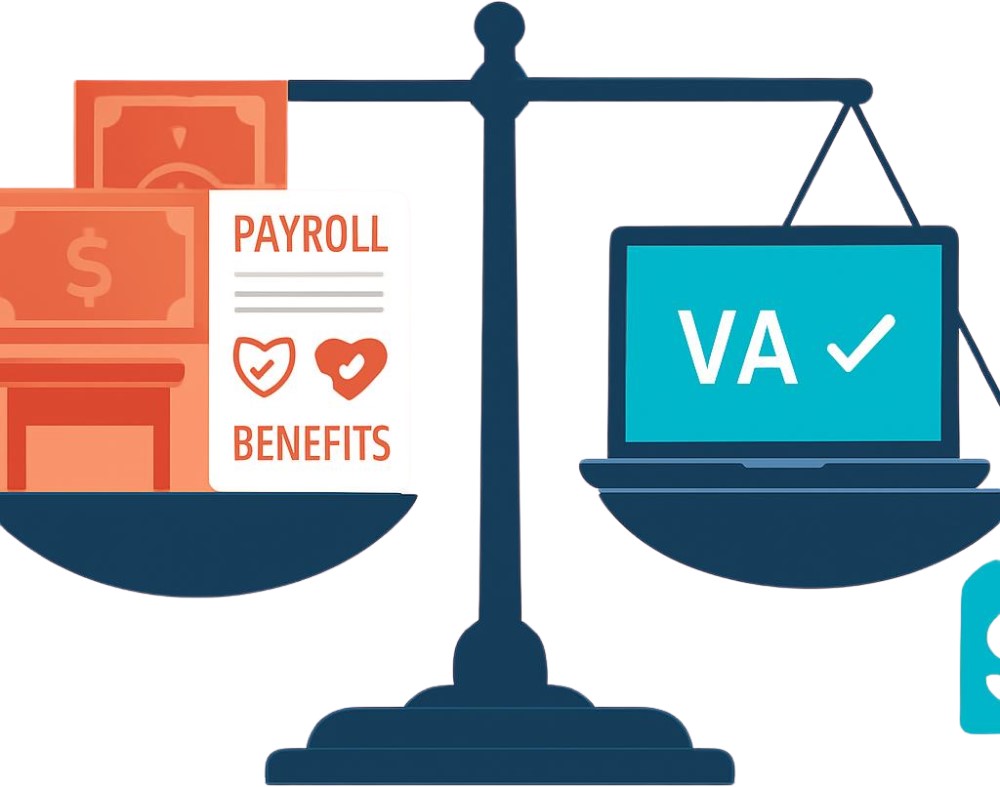
💡 Five prevented lapses per month at $1,100 average premium = $5,500 in preserved annual revenue. That’s nearly 7× the monthly VA cost — from retention alone, before counting producer time freed for new business.
How to Get the Most From a $800/Month Insurance VA Retainer
The difference between a VA retainer that delivers strong ROI and one that feels underwhelming usually comes down to setup — not the VA’s ability. Three things determine whether a $800/month engagement reaches its full value:
Define the scope in writing before day one
Every task should have a name, a frequency, and an expected output. ‘Handle renewals’ is not a scope. ‘Send renewal outreach email 45 days before expiry, follow up by phone at 30 days, flag non-responses to producer at 14 days’ is a scope that a VA can execute without constant supervision.
Give your VA access to the systems they need from week one
AMS access, email templates, carrier portal credentials, and CRM permissions should all be ready before the VA starts — not set up reactively as they hit each wall. Delayed access is the number one reason VA ramp-up takes longer than it should.
Set one or two measurable KPIs and review them monthly
Outstanding requirement resolution time and renewal outreach completion rate are the two metrics that matter most for a typical $800/month scope. Track them monthly — not to micromanage, but to catch drift early and confirm that the investment is producing the expected output.
How Silkee Solutions Structures Insurance Virtual Assistant Cost
Silkee Solutions structures every VA engagement around a defined task scope, so you know exactly what your retainer covers before you sign anything. Every VA is insurance-specialist trained, HIPAA-aware, and fluent in the major AMS platforms — so the first week of work looks like the tenth, not an orientation period. Explore insurance virtual assistant cost and scope with Silkee and see a detailed breakdown of what’s included in each retainer tier.
Frequently Asked Questions
Q1.Is $800/month a realistic insurance virtual assistant cost for a small agency?
For many small to mid-size independent agencies, $800/month is a realistic entry-level retainer for part-time insurance VA support — typically covering around 20 hours per week of operational work. The actual insurance virtual assistant cost varies by provider, scope, and VA specialization level. Some agencies start smaller and expand as they identify additional tasks worth delegating.
Q2.What tasks are typically not included in a standard VA retainer?
Licensed advisory tasks — coverage recommendations, policy changes that require agent authority, E&O-sensitive client advice — always stay with your producers. Most VA retainers also don’t include tasks requiring dedicated software the VA doesn’t already have access to, or specialized work outside the agreed scope. The scope document should define exclusions as clearly as inclusions.
Q3.How quickly does a $800/month insurance VA become cost-effective?
An insurance-specialist VA typically reaches full operational independence within the first one to two weeks — significantly faster than an in-office hire with no prior insurance background. Cost-effectiveness depends on how much producer time was previously absorbed by admin tasks. Most agencies see a positive impact on producer capacity and policy retention within the first 30 days.
Bottom Line
Understanding insurance virtual assistant cost means looking beyond the monthly number to what that number actually buys in task output, hours covered, and retention impact. A well-scoped $800/month engagement covers the operational layer most agencies are currently running on producer time — at a fraction of what an equivalent in-office hire would cost. To see what a transparent, task-specific retainer looks like for your agency, visit silkeesolutions.com or schedule a free 15-minute call.