
South Carolina’s coastal insurance market runs on a structure most other states don’t use. Rather than a single insurer of last resort covering everything, coastal properties often need two separate policies: wind and hail coverage through the South Carolina Wind and Hail Underwriting Association (SCWHUA), plus a companion policy from a standard carrier covering everything else. Getting that coordination right — and understanding when it applies — is genuinely specialized work.
An insurance virtual assistant South Carolina agencies can rely on needs to understand this two-policy structure, not just general hurricane exposure. Here’s what that looks like in practice.
Why South Carolina’s coastal market works differently
South Carolina sits directly in the Atlantic hurricane track — Hurricane Hugo made landfall near the Isle of Palms in 1989 as a Category 4 storm, causing over $7 billion in damage at the time, a figure that would exceed $18 billion today. Since then, coastal underwriting has gotten progressively more specialized, and some standard-market carriers have restricted or stopped writing new coastal policies entirely as a result.
For eligible coastal properties, that often means SCWHUA wind and hail coverage paired with a separate “ex-wind” policy from a standard carrier for the remaining perils. South Carolina’s hurricane deductibles are also structured differently than a flat dollar amount — they’re typically expressed as a percentage of dwelling value, commonly 1% to 5%, which changes the real cost conversation with a client considerably compared to a standard deductible.
What an insurance virtual assistant South Carolina agencies use handles
SCWHUA and companion policy coordination
Your VA tracks which properties need the SCWHUA-plus-companion-policy structure, coordinates the paperwork between the two policies, and keeps both in sync at renewal so nothing lapses on one side while the other stays current.
Wind mitigation documentation
Wind mitigation inspections can reduce the wind portion of a South Carolina premium by 10% to 30%, but only if the documentation is properly submitted and current. Your VA tracks which clients have mitigation credits on file and flags properties that could benefit from a new inspection.
Binding moratorium tracking during active threats
Once a hurricane watch is issued for an area, carriers typically impose a binding moratorium — no new coverage or limit increases until the threat passes. Your VA can track watch/warning status and flag pending applications that need to move before a moratorium takes effect, rather than a client discovering the window closed.
Renewal outreach with deductible clarity
Because South Carolina hurricane deductibles are percentage-based, a client’s real out-of-pocket exposure changes whenever their dwelling coverage amount is adjusted — even if the percentage itself stays the same. Your VA runs renewal outreach that flags this clearly rather than leaving a client to do the math themselves after a claim.
Standard AMS and CRM work
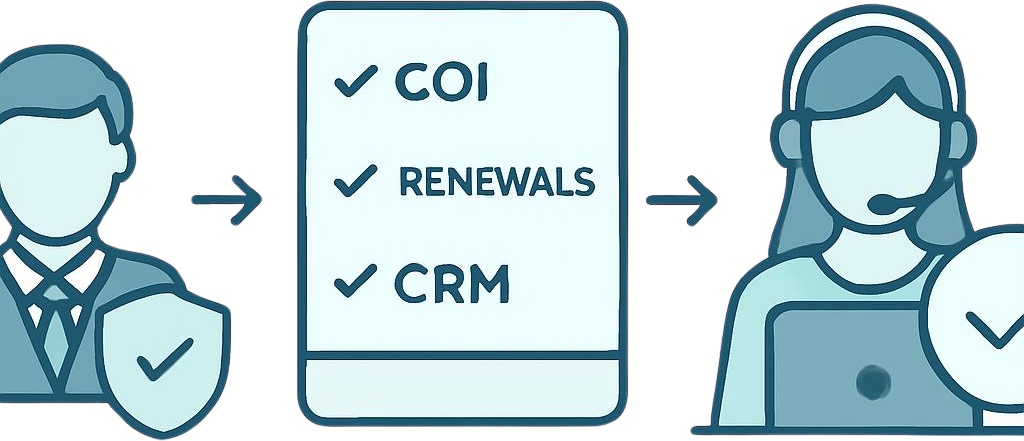
Alongside the South Carolina-specific work, your VA handles the same core administrative load as any agency — policy data entry, COI processing, and CRM management inside whatever platform you run.
What stays with a licensed agent
The SCWHUA/companion-policy structure is exactly the kind of complexity where boundaries matter most. Deciding which combination of coverage a client needs, advising on deductible selection, and any conversation involving coverage adequacy stay with you or your licensed staff. A VA’s role is coordination and documentation — keeping both halves of a two-policy structure organized — not making the coverage decision itself.
Catastrophe season readiness
South Carolina’s Atlantic-facing coastline means catastrophe-season call surges are a real annual consideration. See our general guide to catastrophe surge handling for the full breakdown of FNOL capture, status updates, and triage during peak season. Further up the coast, Virginia presents a genuinely different challenge — regional diversity rather than a single crisis market.
How Silkee supports South Carolina agencies
Our Insurance Concierge package covers SCWHUA coordination, wind mitigation tracking, renewal outreach, and standard policy servicing — scaled up during hurricane season when your agency needs it most.
Book a free consultation, or see how our insurance virtual assistant cost compares to hiring in-house before you reach out.
Frequently asked questions
What is SCWHUA and when does a client need it?
The South Carolina Wind and Hail Underwriting Association provides wind and hail coverage for eligible coastal properties that can’t get it through the standard market. It’s typically paired with a companion “ex-wind” policy from a standard carrier covering other perils. Eligibility depends on location and specific underwriting requirements — a licensed agent determines whether a property qualifies.
How does a percentage-based hurricane deductible actually work?
Instead of a flat dollar amount, the deductible is calculated as a percentage — commonly 1% to 5% — of the dwelling coverage limit. A $300,000 dwelling with a 2% hurricane deductible means a $6,000 out-of-pocket amount before coverage applies, which changes any time the dwelling limit is adjusted.
Can a virtual assistant help track wind mitigation credits?
Yes — tracking which properties have current wind mitigation documentation on file, and flagging ones that could benefit from a new inspection, is exactly the kind of ongoing administrative work a VA can own so mitigation credits don’t quietly lapse.
How fast can a South Carolina agency get started?
Most agencies are live within 5–7 business days of their first call, with no setup fee.