
At some point, every growing sales team hits the same wall. Your closers are buried in CRM data entry. Follow-ups are slipping. You know you need support — but you’re not sure whether to hire in-house or bring on a virtual sales assistant (VSA).
This guide breaks down both options using real cost figures, honest trade-offs, and a practical decision framework. The goal is to help you choose the model that fits your business — not to steer you toward any particular answer.
Cost Comparison: Virtual Sales Assistant vs In-House
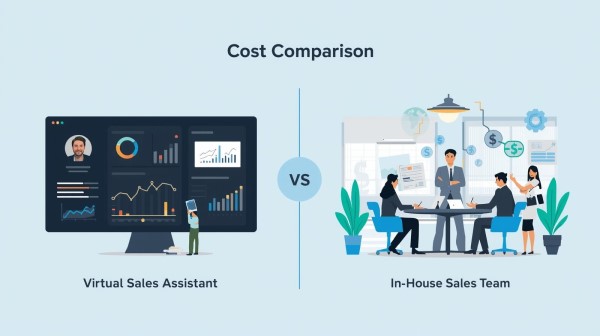
Cost is almost always the first question, so let’s put real numbers on the table. The figures below are based on industry data for a mid-level sales support role in the US.
In-House Sales Support — Year One Costs
| Cost Item | Estimated Range |
| Base salary | $45,000 – $65,000 |
| Employer taxes (FICA, unemployment) | $3,500 – $5,000 |
| Health insurance | $6,000 – $12,000 |
| 401(k) match (4%) | $1,800 – $2,600 |
| Paid time off (15 days) | $2,600 – $3,800 |
| Office space ($250/month) | $3,000 |
| Equipment and software | $2,500 – $4,500 |
| Recruiting costs | $2,000 – $5,000 |
| Onboarding productivity loss (2–3 months) | $5,000 – $8,000 |
| Year One Total | $71,400 – $107,400 |
Virtual Sales Assistant — Annual Costs
| Cost Item | Estimated Range |
| Monthly service fee | $2,500 – $4,500/month |
| Annual total | $30,000 – $54,000 |
| Equipment, office space, benefits | $0 (covered by provider) |
| Recruiting time | None (provider handles) |
| Onboarding period | 1–2 weeks |
| Year One Total | $30,000 – $54,000 |
The typical saving with a VSA is $40,000–$53,000 in year one. Beyond direct cost, the VSA model also eliminates recruiting timelines, severance risk, and fixed overhead during slow periods.
That said, cost alone should not be the deciding factor. The right model depends on how you work, what your team needs, and how much flexibility matters to you.
Six Factors That Should Drive Your Decision
Rather than running through ten factors at surface level, the six below are the ones that tend to actually differentiate outcomes. Work through each honestly.
1. Speed of Deployment
In-house hiring — even when everything goes smoothly — typically runs 4–6 months from job posting to full productivity. That’s 3–4 weeks to post and review applications, 4–6 weeks for interviews and offers, then 2–3 months of onboarding before someone is operating independently.
A VSA from a specialist provider can be up and running within 3–4 weeks. If you’re scaling for a product launch, a busy season, or a gap in coverage, that difference matters significantly.
2. Flexibility and Scalability
In-house staff represent a fixed commitment. You pay the same whether the pipeline is full or quiet, and scaling down means severance, unemployment claims, and legal risk.
VSAs offer genuine flexibility — you can increase hours during Q4 peaks, reduce them in slower quarters, and adjust the arrangement with typically 30 days’ notice. For businesses with seasonal revenue or unpredictable growth curves, that flexibility has real financial value.
3. Specialised Sales Skills
A generalist admin hire may have strong organisational skills but limited exposure to CRM platforms, sales methodologies, or pipeline tools. Training someone from scratch adds months and real cost.
Sales-focused VSA providers typically source candidates with several years of dedicated sales support experience and pre-existing familiarity with platforms like Salesforce, HubSpot, and Pipedrive. If specialised skills matter to your workflow, a VSA may get you there faster and more reliably.
4. Oversight and Management Style
In-house staff are easier to supervise directly. You can give real-time feedback, observe work in progress, and integrate someone into team culture organically. If your work style depends on close, in-person collaboration, or if your processes aren’t yet documented well enough to manage by results, in-house is the more natural fit.
Managing a VSA requires output-based thinking — clear deliverables, structured check-ins, and documented processes. If you’re willing to build that infrastructure, many managers find the shift to results-based management improves productivity across their whole team.
5. Financial Risk and Predictability
With in-house hiring, the financial risk sits with you. A poor fit means severance, unemployment insurance increases, and months of lost productivity. Benefits and overhead continue regardless of output.
VSA arrangements carry lower financial risk. Costs are predictable and consistent. If the fit isn’t right, the adjustment process is significantly simpler. For earlier-stage businesses or those managing cash flow carefully, that predictability matters.
6. Culture and Team Integration
Physical presence has genuine value for team cohesion. In-house staff participate in culture organically — they attend meetings, absorb informal knowledge, and build relationships naturally.
VSAs require intentional inclusion to feel part of the team. Managers who include remote staff in team meetings, celebrate their contributions, and communicate proactively find integration is very achievable. But it does require deliberate effort that in-house arrangements do not.
The Hybrid Approach
A third option is worth considering: one in-house senior sales support person responsible for strategy, institutional knowledge, and team culture — supported by one or more VSAs handling execution, data entry, outreach, and CRM management.
This works particularly well for teams scaling from 5 to 20 people, where the volume of execution work is growing faster than the need for senior oversight. The in-house hire anchors culture and process; the VSA scales output without proportional overhead.
Which Model Is Right for You?

A virtual sales assistant tends to work better when:
- Speed of deployment matters — you need support within weeks, not months
- Your workload fluctuates seasonally or with growth cycles
- You want specialist CRM and sales support skills without a full training investment
- You’re managing cost carefully and need predictable monthly spend
- You already have documented processes or are willing to build them
In-house tends to work better when:
- Your work style requires close, in-person collaboration and real-time oversight
- Company culture and face-to-face team integration are strategic priorities
- Your processes are not yet documented and require organic learning
- You have the budget and timeline for a full hiring and onboarding cycle
A hybrid approach tends to work better when:
- You need strategic ownership in-house but high-volume execution support
- You’re scaling rapidly and can’t hire in-house fast enough to match demand
- You want to test VSA integration before fully committing to the model
What to Look for in a Virtual Sales Assistant Provider
If you decide a VSA is the right fit, provider selection matters. The difference between a poor and good experience often comes down to how well the provider manages sourcing, onboarding, and ongoing accountability.
Key things to evaluate:
- CRM experience — do candidates have hands-on experience with the platforms you use?
- Sales-specific background — general admin experience is different from sales support experience
- Onboarding process — does the provider have a structured setup process, or does that fall entirely to you?
- Backup coverage — what happens when your assigned VSA is unavailable?
- Contract flexibility — can you scale hours up or down, and what does exiting the arrangement look like?
- Communication standards — how are check-ins structured, and what reporting is provided?
Silkee Solutions specialises in virtual sales support for growing businesses, with VSAs experienced in CRM management, pipeline support, outreach, and follow-up. If you want to explore whether a VSA is the right fit for your team, you can learn more on the virtual sales assistant page.
Frequently Asked Questions
What is the real cost difference between a virtual sales assistant and in-house support?
In-house sales support typically costs $71,400–$107,400 in the first year once salary, benefits, taxes, office space, equipment, recruiting, and onboarding are included. A virtual sales assistant from a specialist provider typically runs $30,000–$54,000 annually, with no additional overhead costs. The saving in year one is generally in the range of $40,000–$53,000, though the right choice depends on more than cost alone.
Can a virtual sales assistant be as productive as an in-house hire?
Yes, for most sales support tasks — CRM management, follow-up sequences, pipeline data entry, appointment scheduling, and outreach. The tasks where in-house staff have a genuine advantage are those requiring physical presence, real-time collaboration, or deep immersion in company culture. For execution-focused sales support work, a well-matched VSA with the right experience is typically as productive, and in some cases more so, because they come with specialist skills already in place.
How do I manage a virtual sales assistant effectively?
The key shift is from managing presence to managing output. Define clear deliverables — specific tasks, volumes, and turnaround times — rather than monitoring hours. Use structured daily or weekly check-ins via video call or async tools. Invest time in onboarding documentation: the more clearly your processes are written down, the faster a VSA can work independently. Most managers who struggle with VSA management find the issue is under-documented processes rather than remote working itself.
What happens if the arrangement isn’t working out?
VSA arrangements are significantly easier to adjust than in-house hires. Most providers allow you to change the assigned VSA if the fit isn’t right, and ending the arrangement typically involves 30 days’ notice without severance, unemployment implications, or legal complexity. In-house exits carry substantially more financial and operational risk, particularly if the hire is within the first year.
What should I look for when choosing a virtual sales assistant provider?
Prioritise providers who specialise in sales support rather than general virtual assistance. Confirm the CRM platforms and sales tools their VSAs are trained on. Ask about their onboarding process, backup coverage, and how they handle performance issues. Understand what contract flexibility looks like — can you scale hours up or down, and what does an exit look like if needed? A provider who is transparent about these details before you sign is a good signal of how they operate during the engagement.
How quickly can a virtual sales assistant start adding value?
With a specialist VSA provider, the typical timeline to full productivity is 3–4 weeks: roughly one week to scope requirements, one week for the provider to match and introduce candidates, and one to two weeks for onboarding and process training. The main variable is how well-documented your processes are going in — teams with clear SOPs get to full productivity faster. Compare this to an in-house hire, which typically takes 4–6 months from job posting to full independent contribution.
Summary
Virtual sales assistants offer faster deployment, lower cost, and more flexibility. In-house staff offer closer oversight, stronger culture integration, and a more traditional management dynamic. Neither is universally better — the right answer depends on your team’s working style, your budget, and what you need the role to do.
If cost predictability, speed, and specialist skills are your priorities, a VSA is likely the stronger fit. If your work is deeply collaborative, process-undocumented, or culture-dependent, in-house may serve you better — or a hybrid approach may give you the best of both.
If you’re exploring what virtual sales support would look like for your team, the Silkee Solutions virtual sales assistant page covers what the role covers, how onboarding works, and what to expect from the arrangement.