
Unlike Florida, Louisiana, or South Carolina, Virginia isn’t a property insurance crisis state. The market is genuinely well-regulated and competitive statewide, and the Virginia Property Insurance Association (the state’s FAIR Plan) remains a true last resort rather than a mass destination — most homeowners who work with the right agent can avoid it entirely. What makes Virginia administratively demanding isn’t a market crisis; it’s regional diversity.
An insurance virtual assistant Virginia agencies use needs to handle that diversity — a book that might span high-value Northern Virginia commuter households, coastal Hampton Roads exposure, and rural Southwest Virginia farm risk, all with genuinely different administrative needs. Here’s what that looks like in practice.
Why Virginia’s regional diversity is the real administrative challenge
Virginia’s insurance needs vary more by region than almost any other state on the East Coast. Northern Virginia households tend to focus on high property values, umbrella exposure, and fast servicing for busy commuter families. Richmond and Central Virginia clients typically want home, auto, renters, and life insurance bundled into one manageable relationship. Hampton Roads — Virginia Beach, Norfolk, Chesapeake, Portsmouth, Suffolk, Newport News, Hampton — carries real coastal wind and tidal flooding exposure, with some carriers having pulled back or tightened underwriting in the highest-risk zip codes. Western and Southwest Virginia agencies deal with farm risk, small business coverage, and clients who expect a single dependable point of contact.
A single agency writing across several of these regions is managing genuinely different risk profiles and client expectations at once — which is a different kind of administrative load than a single-peril catastrophe market, but a real one.
What an insurance virtual assistant Virginia agencies use handles
Multi-region policy and renewal tracking
Your VA keeps renewal schedules, coverage types, and regional risk notes organized across a book that might span coastal, urban, and rural risk simultaneously — so nothing gets handled with a one-size-fits-all approach it doesn’t fit.
Hampton Roads coastal and deductible tracking
For the coastal portion of a Virginia book, deductibles can be either a fixed dollar amount or a percentage of Coverage A depending on the specific zip code and carrier. Your VA tracks which policies carry which structure so renewal conversations reflect the real number, not an assumption carried over from a different policy type.
VPIA (FAIR Plan) monitoring for hard-to-place risk
For the small share of clients who end up on Virginia’s FAIR Plan, your VA tracks policy status and can flag when a client might now qualify for standard-market coverage — since VPIA is meant as a temporary solution, not a permanent one, and clients placed there sometimes stay longer than necessary simply because nobody revisits it.
Bundled-policy coordination
For Central Virginia clients running bundled home, auto, and life coverage, your VA keeps the full household relationship organized in one place rather than three disconnected policy records that happen to share a client name.
Standard AMS, COI, and CRM work
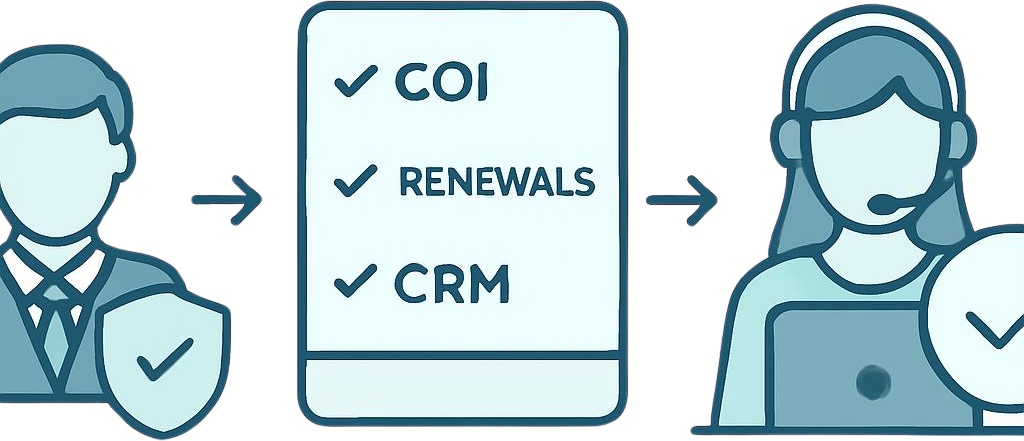
Alongside the regional-specific work, your VA handles the same core administrative load as any agency — policy data entry, certificate processing, and CRM management inside whatever platform you run.
What stays with a licensed agent
Regional diversity doesn’t change licensing boundaries. Coverage recommendations for any specific region, advice on whether a client should move off the FAIR Plan, and any conversation involving policy interpretation stay with you or your licensed staff. A VA’s role is keeping the administrative side organized across regions, not making region-specific coverage calls.
Catastrophe season readiness for coastal clients
For the Hampton Roads portion of a Virginia book specifically, catastrophe-season readiness matters the same way it does further south. See our general guide to catastrophe surge handling for the full breakdown of FNOL capture, status updates, and triage during peak season.
How Silkee supports Virginia agencies
Our Insurance Concierge package covers multi-region policy tracking, renewal coordination, and standard policy servicing — scaled to fit a book that might span several distinct Virginia markets at once.
Book a free consultation, or see how our insurance virtual assistant cost compares to hiring in-house before you reach out.
Frequently asked questions
Is Virginia a high-risk insurance market like Florida or Louisiana?
No — Virginia’s market is genuinely well-regulated and competitive statewide. Some coastal Hampton Roads zip codes see tighter underwriting and higher rates due to wind and tidal flooding exposure, but this is localized, not a statewide crisis the way it has been in Florida or Louisiana.
What is VPIA and how often do clients actually need it?
The Virginia Property Insurance Association is the state’s FAIR Plan, providing basic property coverage when the standard market won’t. It’s intended as a temporary, last-resort solution — most Virginia homeowners who work with the right agent can find standard-market coverage, even in higher-risk areas.
Can a virtual assistant handle an agency book spanning multiple Virginia regions?
Yes — this is one of the more common reasons Virginia agencies bring on dedicated support. A VA trained on your specific book can track the different renewal patterns, risk notes, and deductible structures across regions without treating every policy identically.
How fast can a Virginia agency get started?
Most agencies are live within 5–7 business days of their first call, with no setup fee.