
Short answer: A flood insurance virtual assistant handles the non-licensed administrative work behind NFIP flood policies — WYO carrier tracking, Agency Registry maintenance, application processing, and the 30-day waiting period that applies to nearly every new policy — while your licensed staff handles the actual sale and coverage advice. Flood insurance runs through a federal structure (FEMA’s NFIP) rather than state insurance departments, which makes it administratively distinct from every other line an agency writes.
The National Flood Insurance Program is the nation’s largest single-line insurance program — roughly 4.7 million policyholders, nearly $1.3 trillion in coverage. Most agencies write flood policies through the Write Your Own (WYO) Program, where about 47 to 50 private carriers sell and service NFIP policies in their own name, while FEMA retains responsibility for underwriting the actual flood risk. That structure creates real administrative work most agencies underestimate until they’re doing it.
Why flood insurance administration is genuinely different
Flood coverage isn’t regulated the way P&C, life, or Medicare products are. FEMA sets the rates and coverage terms, not your state insurance department, and a policy is only available in the roughly 23,000-plus communities that participate in the NFIP. Every agency writing flood insurance has to choose between two paths — the WYO Program (writing through a participating private carrier) or NFIP Direct (contracting straight with FEMA’s servicing agent) — and the NFIP’s Agency Registry only allows an agency to be associated with one WYO company or NFIP Direct per physical location, which means the choice has real downstream administrative consequences.
On top of that, nearly every new flood policy carries a mandatory 30-day waiting period before coverage takes effect — a detail that trips up clients constantly, especially anyone trying to bind flood coverage right before or during a storm. Many states also have their own flood insurance training requirements layered on top of the federal structure.
What a flood insurance virtual assistant handles
WYO carrier and NFIP Direct tracking
Your VA keeps track of which WYO carrier (or NFIP Direct) your agency writes through at each location, maintains accurate Agency Registry information, and manages the administrative side of any changes to that arrangement.
Application processing and the 30-day waiting period
Your VA processes flood insurance applications and proactively communicates the 30-day waiting period to clients — especially important for closings, refinances, and any client shopping for coverage during an active weather threat, where the timing genuinely matters.
Community and flood zone documentation
Your VA organizes flood zone determinations and community participation documentation for each policy, keeping the paperwork trail clean for both underwriting and any future claim.
Renewal tracking
Your VA runs renewal outreach on your flood book the same way as any other line, flagging upcoming renewals early enough that a lapse never happens simply because nobody followed up. If flood admin is just one piece of a larger workload, see our broader guide to outsourcing insurance admin tasks.
Training and requirement tracking
Where your state requires specific flood insurance training, your VA tracks completion status and renewal deadlines for your licensed staff, the same discipline used for AHIP tracking on the Medicare side of an agency’s book.
What stays with a licensed agent
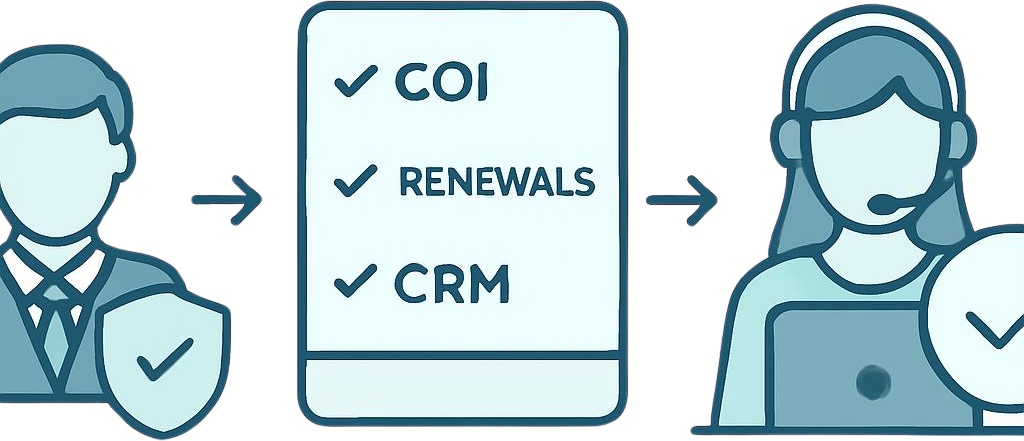
Any licensed P&C agent can sell NFIP flood insurance, subject to their state’s training requirements — but coverage advice, rate quoting, and the actual sale stay with that licensed agent regardless of how administratively heavy the NFIP paperwork gets. A VA’s role is keeping the WYO/NFIP Direct relationship, applications, and renewals organized — not advising a client on flood risk or coverage adequacy.
This isn’t compliance advice. NFIP rules and state-specific training requirements change, and FEMA is the authoritative source for current program details — confirm specifics directly with FEMA’s NFIP resources or your compliance contact rather than relying on general guidance like this.
Flood exposure and catastrophe season
Flood risk and hurricane season overlap heavily in coastal and near-coastal markets. See our general guide to catastrophe surge handling for how claims and call volume spikes are managed during active weather events, and our state-specific guides for Florida, Louisiana, and South Carolina agencies dealing with flood exposure directly.
How Silkee supports flood-writing agencies
Flood insurance administrative support is included within our Insurance Concierge package — most agencies writing flood coverage also need standard P&C servicing, and it’s more efficient to have one dedicated VA handle both than to split the work across providers.
Book a free consultation, or see how our insurance virtual assistant cost compares to hiring in-house before you reach out.
Frequently asked questions
What is the difference between WYO and NFIP Direct?
WYO (Write Your Own) means a private insurance company sells and services the NFIP flood policy under its own name, while FEMA retains the underwriting risk. NFIP Direct means the agency contracts directly with FEMA’s servicing agent instead. An agency can only be registered with one WYO company or NFIP Direct per physical location in the NFIP’s Agency Registry.
Why does the 30-day waiting period matter so much?
Most new flood policies don’t take effect until 30 days after purchase. This catches clients off guard constantly — especially anyone trying to bind coverage right before a storm, or during a real estate closing with a tight timeline. Clear, proactive communication about this timing is one of the more valuable things a VA can own.
Can a virtual assistant help determine flood zone eligibility?
A VA can organize and document flood zone and community participation information gathered for a policy, but any coverage recommendation based on that information stays with a licensed agent.
How fast can a flood-writing agency get started?
Most agencies are live within 5–7 business days of their first call, with no setup fee.