
Nobody warns you about the paperwork when you go independent.
You make the leap — you have your license, a growing book of business, and the freedom to build something on your own terms. Then reality sets in. You’re spending your Tuesday afternoon chasing a lost run request for a commercial account. Your Wednesday morning disappears into a stack of certificate of insurance (COI) requests. By Thursday, you realize you haven’t made a single prospecting call since Monday.
This is the cycle that traps independent insurance agents. Not a lack of leads. Not a weak sales pitch. It’s the back office swallowing up the hours that should be going toward growth.
A virtual assistant for independent insurance agents is one of the most direct ways to break that cycle — and it’s more accessible than most agents realize.

What Exactly Does an Insurance Virtual Assistant Do?
Before we go further, let’s be specific. An insurance virtual assistant (VA) is a trained remote professional who handles the administrative and operational side of your agency. They are not replacing your producer role. They are handling everything that doesn’t require your license.
That distinction matters. A good insurance VA frees you from the clerical work without touching the tasks that legally need you: coverage advice, policy binding, and client consulting.
Here’s what a VA for an independent insurance agent typically handles day to day:
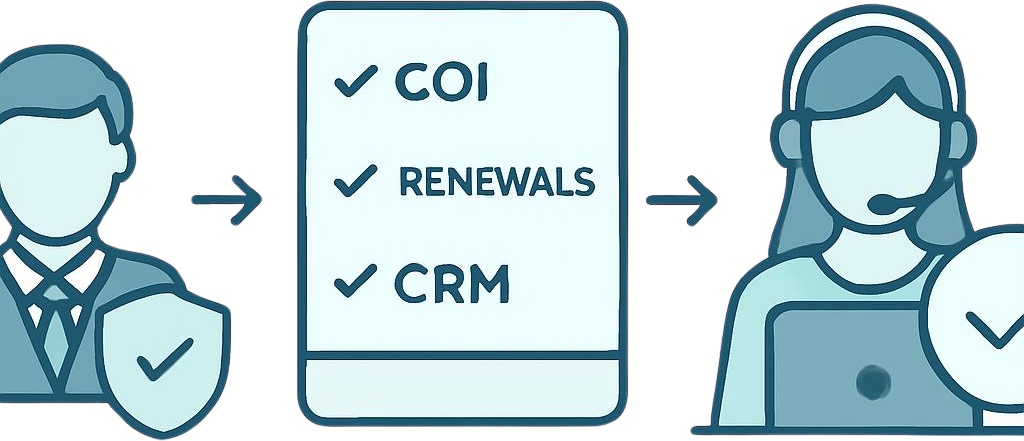
Certificate of Insurance (COI) Processing
COI requests are one of the biggest time drains in commercial lines. A VA logs in to your AMS, pulls the correct policy data, issues the certificate, and sends it to the requesting party — often within the same business day. What used to eat 20 to 30 minutes per request becomes something you never touch again.
Policy Renewal Preparation
Renewals don’t fall apart because of bad pricing. They fall apart because nobody started the conversation 60 days out. A VA monitors your upcoming renewal list, pulls current policy data, prepares comparison summaries, and sends initial renewal notices — so by the time you get involved, the groundwork is already done.
CRM and AMS Data Entry
Every new lead, every application update, every coverage change needs to be logged. When you’re handling it yourself, it piles up. A VA keeps your CRM and agency management system current so you always have accurate, up-to-date records without spending an hour at the end of each day catching up.
Claims Follow-Up
When a client files a claim, they want to know what’s happening. A VA handles the follow-up communications with the carrier, documents claim status updates, and keeps your client informed — maintaining trust without requiring your constant attention.
Quoting Support
Depending on your setup, a VA can handle data gathering for quote submissions: pulling prior policies, collecting application details, running information through comparative raters, and organizing quote results for your review. You make the coverage decisions; they handle the legwork.
Inbox and Calendar Management
For a solo agent, an unmanaged inbox is a liability. Missed emails from carriers, overlooked follow-up reminders, double-booked calls — these are all preventable with a VA managing your communications and calendar.

Why Independent Agents Need This More Than Anyone
Captive agents work inside a support structure. There’s usually an agency principal, an office manager, and shared administrative staff. When a COI request comes in, it goes to the back office.
As an independent agent, you are the back office.
That’s not a complaint — it’s the reality of independence. You traded institutional support for the ability to access multiple carriers, serve more clients, and build equity in your own book. But without any administrative infrastructure around you, every piece of support work lands on your desk.
The agents who scale successfully don’t necessarily work harder than the ones who stagnate. They delegate faster.
A virtual assistant gives an independent agent the equivalent of a back-office function at a fraction of the cost of hiring in-house. You’re not paying for office space, benefits, or full-time hours when you only need part-time support. You pay for the tasks that get done.
The Real Cost of Not Delegating
Here’s a number worth sitting with: if you’re billing your time as a licensed producer at $150 per hour in gross commission value, and you’re spending 15 hours a week on admin tasks, that’s $2,250 worth of selling time you’re handing over to paperwork every single week.
Over a year, that’s more than $117,000 in unrealized revenue potential — not because you lacked the skill to close, but because you were too busy processing endorsements to make the call.
The decision to hire a VA for your insurance agency isn’t a cost. It’s a correction.
Most independent agents who make the switch describe the same experience: the first two weeks feel like they’re spending money without seeing results. By week six, they can’t imagine going back.
What to Look for When Hiring an Insurance VA
Not all virtual assistants are the same. A general VA — the kind you’d find on a freelance marketplace handling calendar management and email replies — is not equipped for insurance back office support. Insurance work has real compliance requirements, carrier portal nuances, and AMS-specific workflows that take time to learn.
When you’re evaluating a VA for your independent agency, look for these qualifications:
- Insurance-specific training. Has the VA worked inside an insurance agency before, or been trained specifically on insurance workflows? Can they navigate Applied Epic, AMS360, EZLynx, or HawkSoft without a weeks-long onboarding process?
- Understanding of licensed vs. unlicensed tasks. A professional VA knows exactly where the line is. They handle data, documents, and communication. They never advise on coverage, bind policies, or take actions that require a producer license. This isn’t just about efficiency — it’s about your E&O exposure.
- Data security protocols. You are handling sensitive client information: Social Security numbers, financial records, business data. Your VA must operate under strict confidentiality agreements with secure remote access procedures.
- US time zone availability. Most independent agents in the US need same-day turnaround on requests. A VA working in a compatible time zone ensures that COI requests, claims follow-ups, and client communications don’t wait until the next morning.
- References from insurance clients. Ask specifically for clients in the insurance space. A VA who has supported commercial lines work at an independent agency is a fundamentally different hire than one who has handled general administrative tasks.
How Silkee Solutions Supports Independent Insurance Agents
At Silkee Solutions, we built our Insurance Concierge service specifically around the workflows that independent agents deal with every day.
We’re not a general VA marketplace. We work with insurance agents and sales professionals — people who need support that understands P&C terminology, knows how to navigate carrier portals, and can be trusted with sensitive client data.
Here’s what working with us looks like in practice:
- Onboarding is structured, not chaotic. We document your specific workflows, identify your AMS and CRM tools, and learn your agency’s preferences before we start. Most clients are fully operational within the first week.
- You set the scope. Start with COI processing only. Add renewal prep. Expand to full back-office support as confidence grows. You’re not locked into a one-size-fits-all service model.
- We work in your time zone. Our team operates on US schedules, which means your clients get same-day responses and your requests don’t sit in a queue overnight.
- Transparent communication. You get regular updates on task status, completed work logs, and direct communication with your VA — not a ticketing system where requests disappear into a black hole.
Independent agents who work with Silkee typically reclaim 10 to 20 hours per week within the first 30 days. That’s 10 to 20 additional hours for prospecting calls, client meetings, and the strategic work that actually grows a book of business.
Common Questions Independent Agents Ask Before Hiring a VA
I’m worried about confidentiality. How is client data protected?
Every Silkee VA operates under a signed confidentiality agreement with defined data security protocols. We take E&O risk seriously and structure our work accordingly.
My workflows are specific to my agency — will they actually understand them?
Yes, with proper onboarding. We document your processes, and our VAs are trained on the most common insurance platforms. If you use a specific tool or process, we build that into the onboarding.
What if I only need support a few hours a week?
We offer flexible arrangements. Many independent agents start with a smaller engagement — 10 to 15 hours per week — and scale from there once they see the impact.
How is this different from hiring someone on Upwork?
A general freelancer needs weeks of insurance-specific training before they’re useful. They also come with replacement risk — if they leave, you start over. With Silkee, you have a service structure behind your VA, not just an individual.
The Bottom Line
If you’re an independent insurance agent spending more than 10 hours a week on tasks that don’t require your license, you have a delegation problem — not a growth problem.
A virtual assistant for independent insurance agents isn’t a luxury for large agencies. It’s a practical tool that gives solo operators the back-office function they need to compete, retain clients, and grow without burning out.
The agents who figure this out early don’t work more hours. They work on the right things.
If you’re ready to stop processing COIs on a Friday afternoon and start focusing on what you actually built your agency to do, Silkee Solutions is ready to help. Schedule a free consultation and let’s build a support structure that fits your agency.
Quick Recap: What a VA Does for Independent Insurance Agents
- Processes COI and endorsement requests
- Prepares renewal files 60 to 90 days in advance
- Keeps your AMS and CRM updated daily
- Handles claims follow-up and carrier communication
- Supports quoting data collection
- Manages your inbox and calendar
The work is real. The time savings are real. And the growth that comes from having your hours back is very real.