
Finding the best virtual sales assistant for your business is harder than it looks — not because good options don’t exist, but because most comparison articles are written by the companies being compared. If you’re a small business owner, an independent insurance agent, or a sales professional who doesn’t need a household-name platform with enterprise pricing and a six-month onboarding process, this guide is for you. We’ll walk through what actually separates capable VA services from expensive ones, what to look for before you sign anything, and the mistakes that cost businesses time and money before they find the right fit.
What “Best” Actually Means for a Small Business — and Why Big Platforms Often Aren’t It
The most-marketed virtual sales assistant services — BELAY, Boldly, MyOutDesk — are genuinely good. They’re also built for companies with HR departments, structured onboarding teams, and budgets that absorb $3,500–$6,000 per month without much deliberation. For a solo insurance agent or a five-person sales team, that’s not the right starting point.
What small business owners actually need from a sales VA looks different:
Sales-specific task coverage, not general admin. A general VA can manage your calendar. What most small sales operations need is someone handling CRM updates after calls, running follow-up sequences on cold leads, tracking proposal status, and making sure nothing falls out of the pipeline between Monday and Friday. These are fundamentally different skill sets.
Fast onboarding with low process overhead. Enterprise VA platforms often require weeks of discovery sessions, documentation reviews, and role-definition work before an assistant touches a task. For a business that needs help now, that timeline doesn’t work. The best services for small operators get an assistant productive within a week — because they’ve structured the matching and briefing process upfront rather than pushing it onto the client.
Honest scope. We consistently see small business owners sign up for a VA service expecting one thing — say, outbound prospecting — and discovering three weeks in that their package only covers reactive tasks. The services that work best for smaller operations are transparent about what each package covers, what it doesn’t, and when you’d need to upgrade.
Month-to-month flexibility. A 12-month contract made sense when hiring was difficult and alternatives were scarce. In 2026, locking a small business into a year-long commitment on a service they’re still evaluating is a vendor-protection move, not a client benefit. Look for 30–60 day terms after an initial trial.
The practical test: before evaluating any provider, list your five most time-consuming recurring sales tasks. If the provider’s package covers at least three of them specifically — not vaguely — it’s worth exploring further.
What to Look For Before You Choose a Sales VA Service
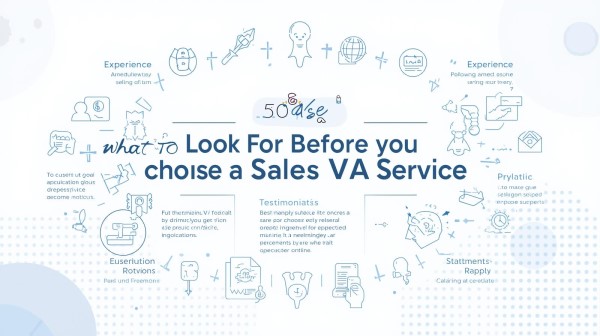
Once you’ve ruled out services that don’t fit your size or budget, here’s the framework we use when advising clients on what to look for:
1. Industry familiarity, not just task familiarity. A VA who understands insurance renewals, carrier follow-up windows, and why a lapsed policy matters is more useful to an independent agent than someone who has done “general sales support.” Ask specifically: has the assistant worked with clients in your industry? What CRM systems have they used?
2. Communication structure. How does the assistant report progress? Weekly summaries, shared task boards, or daily check-ins each suit different working styles. There’s no universal right answer — but there should be a defined answer before you start.
3. Replacement policy. Fit matters. Even with a strong matching process, sometimes the first assistant isn’t the right one. A reliable service offers free role replacement without requiring you to restart a contract or pay additional fees.
4. Data handling. Your CRM contains client contact data, policy information, and pipeline details. Ask explicitly: where is data stored, who has access, and what happens to it if you cancel?
5. Response to a specific scenario. During a sales call with any provider, describe a realistic task: “A prospect requested a proposal two weeks ago. We sent it. They haven’t responded. How would your assistant handle follow-up from here?” A strong provider gives you a specific answer. A weak one gives you a process diagram.
The goal is to find a service that fits your actual workflow — not one that asks your workflow to fit around it.
Why Colorado Small Businesses Face This Decision Differently
Colorado’s independent business community is one of the most active in the Mountain West. Denver alone has 684,700 registered small businesses, and independent insurance agents operate across a market that spans fast-growing suburban corridors like Aurora, Centennial, and Castle Rock as well as rural areas where a single agent handles a wide book of business without administrative staff.
What this creates in practice is a specific gap: Colorado-based agents and sales operators often run lean by design — they’ve chosen independence over corporate employment specifically to avoid overhead. Hiring a full-time in-house admin defeats the purpose. But the admin work doesn’t go away.
The Mountain West also has a particular business culture around trust and referral networks. Clients expect prompt follow-up, organised communication, and consistency — and the agents who deliver that reliably tend to grow through referral faster than those who don’t. A sales VA who handles follow-up sequences and renewal reminders isn’t just saving time; they’re directly supporting the client relationship quality that drives referral growth in Colorado’s community-oriented market.
For this reason, the best fit for most Colorado small operators isn’t a national platform — it’s a service that understands the pace and relational quality the market expects.
Common Mistakes Businesses Make When Choosing a Sales VA

Hiring for the wrong metric — hourly rate. The cheapest hourly VA rate rarely produces the best outcome for sales-specific work. A $10/hour general VA who needs two hours to understand what a $25/hour specialist completes in 20 minutes isn’t actually cheaper. For sales tasks especially — where a delayed follow-up or a missed CRM entry has downstream revenue consequences — quality and speed matter more than rate.
Not defining tasks before the first week. We consistently see new clients hand an assistant a vague brief — “help with sales stuff” — and then wonder why the first week feels unproductive. The best VA engagements start with a written task list: specific, recurring, measurable. “Update HubSpot after every discovery call within two hours” is a task. “Help with CRM” is not.
Expecting a VA to also be a strategist. A virtual sales assistant executes — they follow up, update, schedule, track, and report. They are not a sales manager, a pipeline analyst, or a closer. Small businesses that onboard a VA hoping they’ll also diagnose why conversion rates are low or redesign the sales process tend to be disappointed. The two functions are complementary, but they’re not the same role.
Ignoring time zone alignment. For insurance agents handling time-sensitive carrier communications or sales teams managing inbound leads, a VA operating in a significantly different time zone can create response gaps. Asking specifically about working hours and overlap time before signing is worth the 60 seconds it takes.
Skipping the trial period evaluation. Most services offer a 30-day trial or a first-month evaluation period. Treat it like a real trial — track what’s getting done, what’s falling through, and whether communication is easy. If you’re not assessing it actively, you’ll reach month three without a clear picture of whether it’s working.
Frequently Asked Questions
Q: How is a virtual sales assistant different from a general virtual assistant? A: A general VA handles a broad range of admin tasks — inbox management, scheduling, data entry. A virtual sales assistant is specifically trained in sales workflows: CRM management, lead follow-up sequences, pipeline tracking, proposal management, and sales reporting. If your main pain points are in the sales process rather than general office admin, a sales-specific assistant will be significantly more useful than a generalist.
Q: What does a virtual sales assistant typically cost per month? A: For a dedicated, sales-trained assistant working part-time hours, monthly retainer costs generally range from $1,500 to $3,000 depending on scope and the provider. Full-time equivalent support tends to run $3,000–$4,500 with established agencies. Hourly arrangements exist but typically cost more over time than a fixed monthly retainer for consistent, ongoing work.
Q: Can a sales VA work inside my existing CRM without me having to switch tools? A: Yes, in most cases. The better VA services train their assistants across the major CRM platforms — HubSpot, Salesforce, Pipedrive, Zoho, and industry-specific tools like AgencyZoom for insurance. Before starting, confirm which CRM you use and ask specifically whether the assistant has hands-on experience with it, not just general familiarity.
Q: How long does onboarding typically take before an assistant is actually useful? A: With a well-structured service, five to seven business days is realistic. The first two to three days typically cover process documentation — your assistant learns your pipeline stages, follow-up cadences, CRM setup, and communication preferences. By the end of week one, most recurring tasks should be running. If onboarding takes longer than two weeks, that’s usually a sign the provider’s matching process is under-developed.
Q: Is a virtual sales assistant a good fit for a solo insurance agent? A: It depends on task volume. If you’re spending more than 90 minutes per day on non-billable admin — policy tracking, follow-up emails, carrier coordination, renewal reminders — a part-time VA almost certainly pays for itself in recovered selling time. If your admin load is lighter, a few hours per week of on-demand support may make more sense than a full monthly retainer.
Conclusion
The best virtual sales assistant service isn’t the most marketed one — it’s the one that matches your task list, your communication style, your industry context, and your budget without locking you into terms that don’t protect you. For insurance agents and sales teams specifically, the right fit prioritises speed to productivity, honest scope definition, and sales-specific skills over general admin capability.
Different businesses need different things. A solo agent in Colorado has different requirements than a five-person SaaS sales team in Texas — and the right provider for one may not suit the other at all.
For businesses looking for dedicated sales pipeline support — follow-up, CRM management, and appointment coordination — Silkee Solutions offers a Virtual Sales Assistant service built around fast onboarding and flexible month-to-month plans. silkeesolutions.com/virtual-sales-assistant/
The clearer you are on what you need before you start shopping, the faster you’ll find something that actually works.